Cordless vacuum cleaners: finally see the dust.
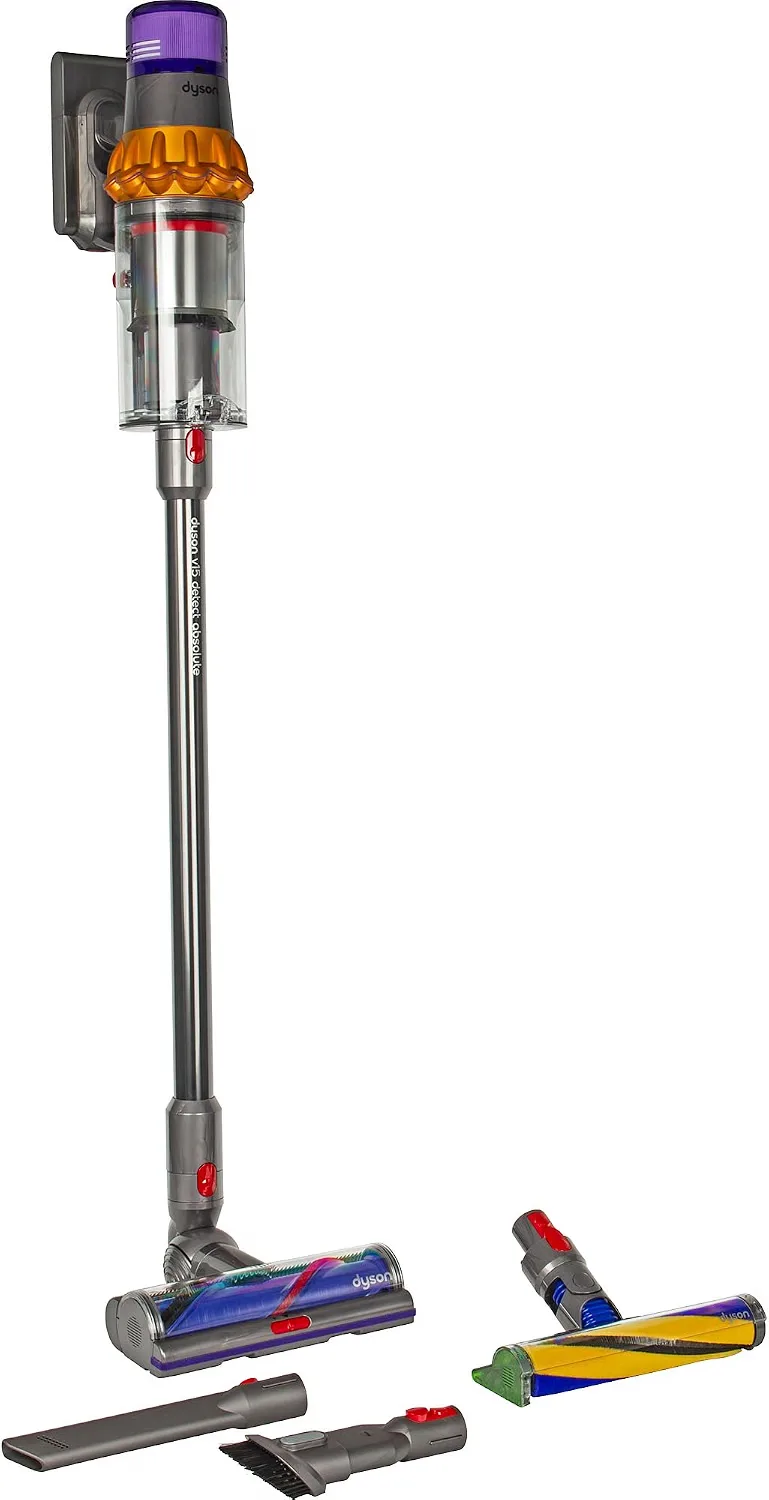
Which cordless stick vacuum should you choose in 2026? Our criteria (suction, runtime, filtration, cleaner heads, weight, upkeep), our practical guides and our reference model, the Dyson V15 Detect Absolute: a laser, a particle sensor and up to 60 minutes of runtime in Eco mode.
- 60 minEco runtime
- 0.76 LBin
- 125,000rpm
- 2 yearsGuarantee
- Laser
- Piezo sensor
- LCD screen
- Up to 60 min
- 125,000 rpm
- 0.76 L bin
- HEPA filtration
- Removable battery
Move your cursor. The dust appears.
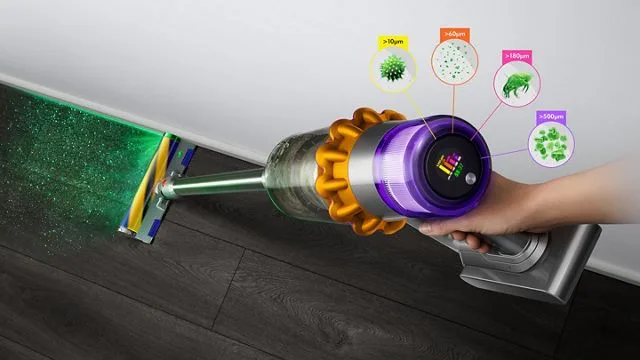
Hover over the picture, or slide your finger across it, to light it up like the V15’s laser and suck up the particles. Just a visual demonstration: in real life, the beam runs low along the floor and is designed for hard floors.
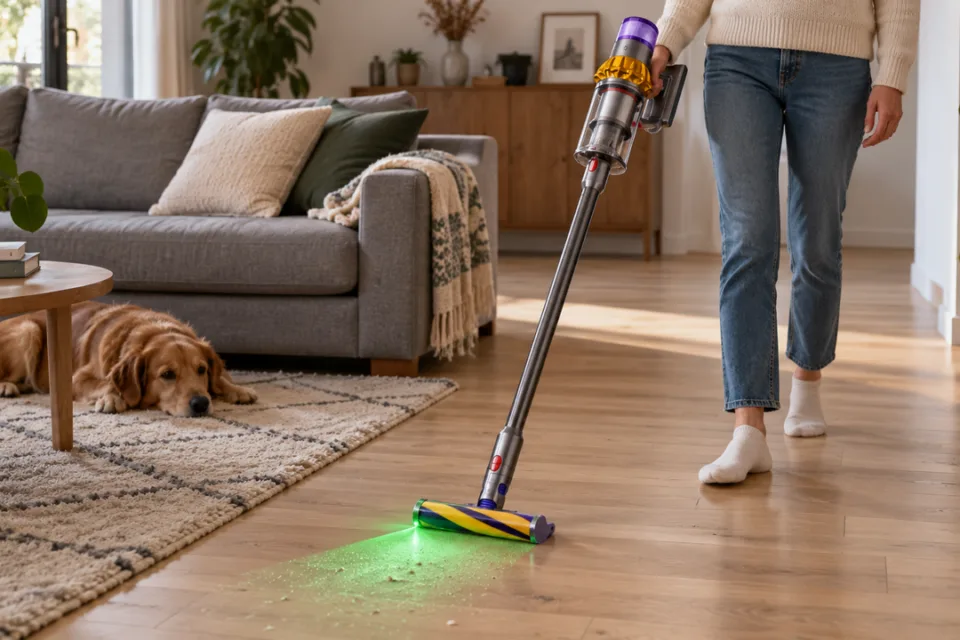
Interactive illustration: the counter is a game, not a measurement. The real V15 sensor sorts particles by size on its LCD screen.
Technology that sees, measures and filters.
The five strengths of the Dyson V15 Detect Absolute. Select a feature to see it in a picture.
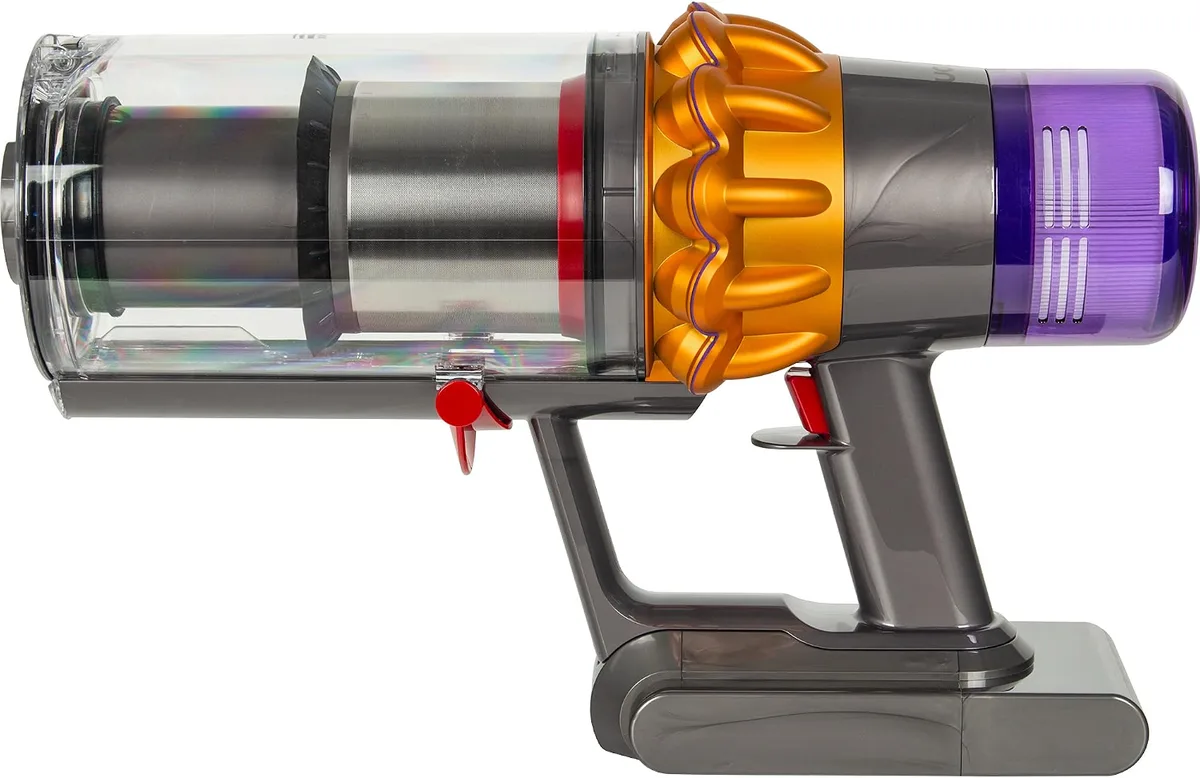
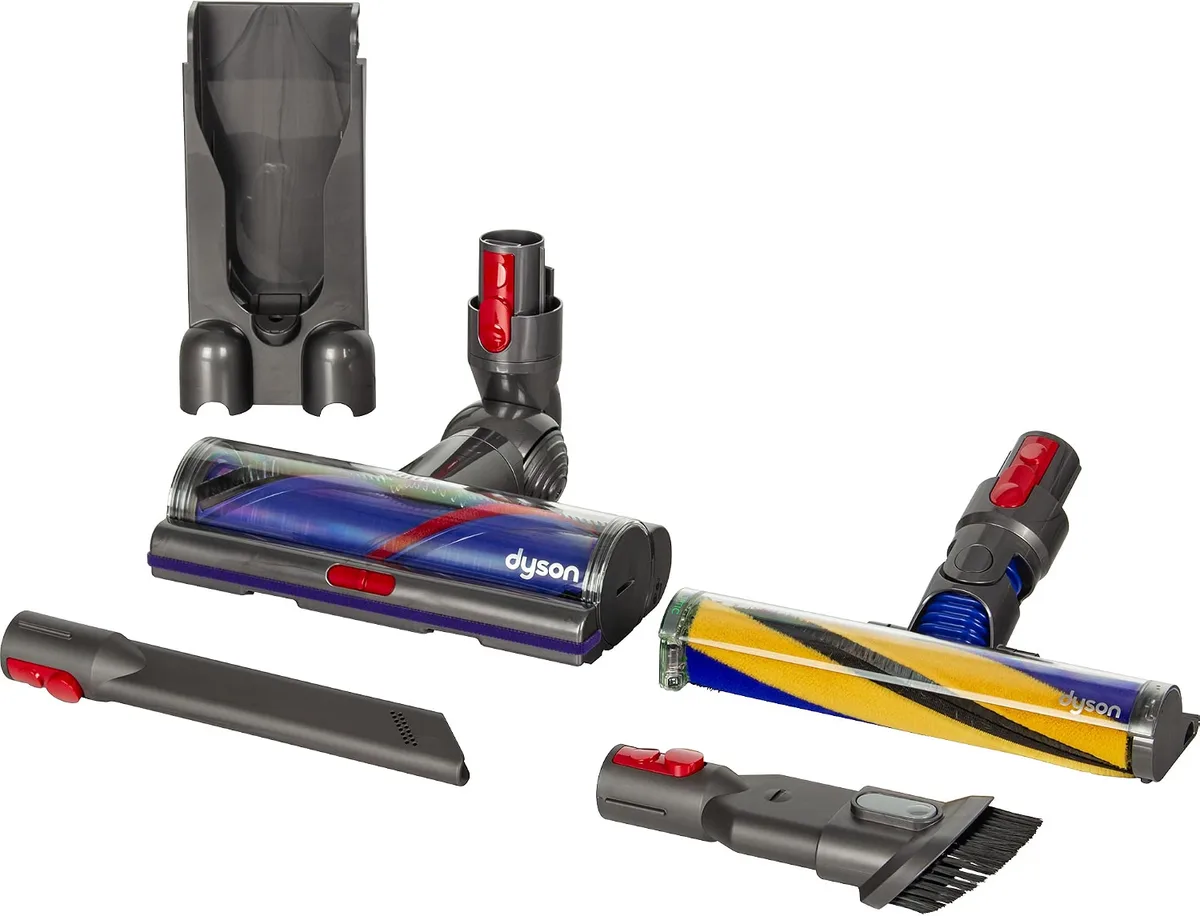
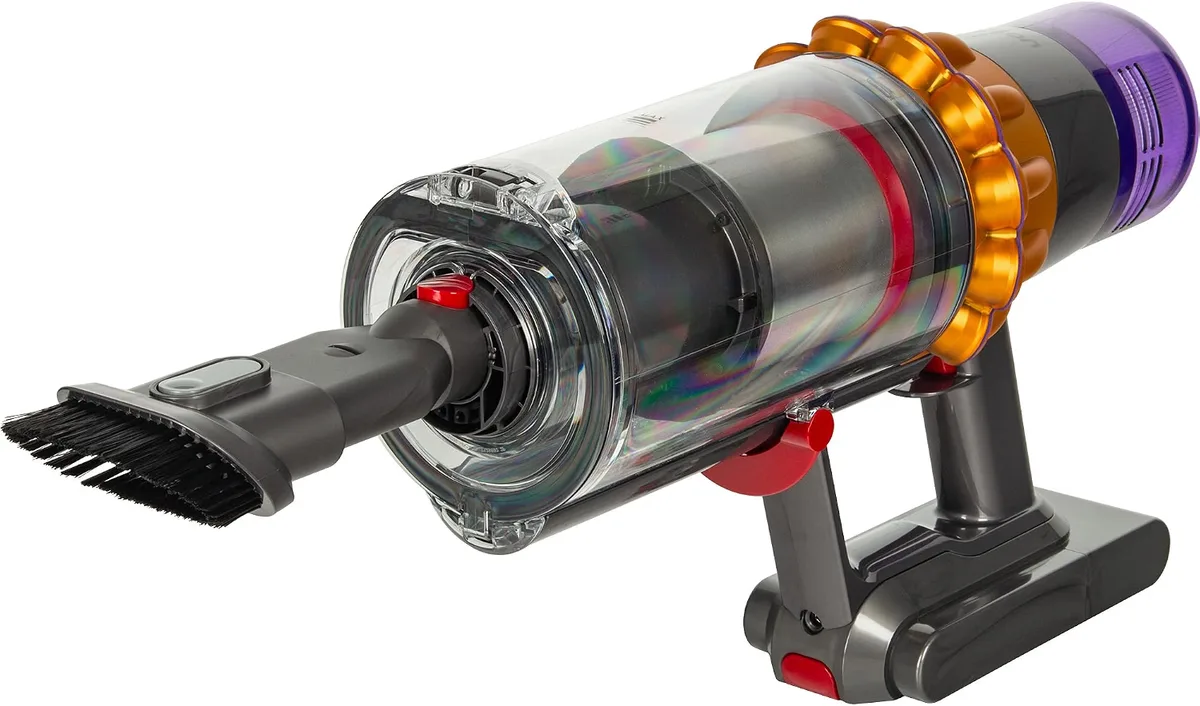
- 60 minMaximum claimed runtime (Eco)
- 125,000Motor revolutions per minute
- 14Cyclones
- 0.76 LBin capacity
Guide contents
The essentials in 30 seconds:
- A cordless stick vacuum runs on a battery, comes out in seconds and often converts into a handheld vacuum. It is the machine for quick, frequent cleaning.
- High-end models now replace the cylinder vacuum in many homes, provided you accept a smaller bin and a runtime that depends on the mode you choose.
- The criteria that matter: measured suction, real runtime in each mode, cleaner heads suited to your floors, filtration, weight in the hand and ease of upkeep.
- The minutes quoted almost always refer to the most economical mode: at full power, runtime drops sharply.
- Our pick, the Dyson V15 Detect Absolute, combines a laser that reveals dust on hard floors, a sensor that counts particles, a head that untangles hair and up to 60 minutes in Eco mode according to Dyson.
Comparison: the best cordless vacuum for your needs
There is no such thing as the best stick vacuum in absolute terms; there is the best machine for your home, your floors and your habits. A family with a dog, a large rug and a staircase does not have the same needs as someone living alone in a tiled studio flat. This comparison places the main families of machines against the criteria that genuinely change everyday life, then names the best choice for each profile.
| Criterion | Dyson V15 Detect Absolute | Entry-level stick | Mid-range stick | Cylinder vacuum |
|---|---|---|---|---|
| Power supply | Click-in removable battery | Battery, often built in | Battery, sometimes removable | Mains cable |
| Runtime | Up to 60 min in Eco, 5 min in Boost (Dyson) | Shorter, highly variable | Varies by model | Unlimited |
| Suction | 230 to 240 AW in Boost depending on version | Much lower | Intermediate | Strong, rarely given in AW |
| Detection tools | Laser, piezo sensor, LCD screen | None | Sometimes LED lighting | None |
| Bin or bag | 0.76 L bin | Often a smaller bin | Medium-sized bin | Large bag or bin |
| Weight in the hand | About 3 kg | Often lighter | Variable | Only the wand is carried |
| Ideal for | The single machine of a demanding household, mixed floors, pets | Small area, quick top-ups | Flats, regular use | Large house, long weekly clean |
This table shows trends: values vary from one model to another, and only specification sheets and independent tests allow two machines to be compared precisely. To refine your choice, our calculator estimates your cleaning time and compares it with the claimed runtime.
What is a cordless stick vacuum?
A cordless stick vacuum is an upright vacuum powered by a battery. It consists of a main body that you hold by a handle, a wand and a floor head. Most recent models are known as 2-in-1: remove the wand and the main body becomes a handheld vacuum for the sofa, the car or the stairs.
For a long time, the cordless stick was a back-up appliance: not very powerful, with a runtime of about fifteen minutes, useful for crumbs after a meal. Digital motors, lithium-ion batteries and motorised heads changed all that. Today’s high-end models have enough suction to deal with rugs and carpets, and they have replaced the cylinder vacuum in many homes.
Its big advantage comes down to one word: availability. It hangs on the wall, charged and ready in two seconds. You vacuum more often, in short sessions, so dust never gets the chance to build up. It is often this change of habit, more than raw power, that makes a home cleaner.
There are limits all the same. A stick vacuum carries its weight in the hand, holds less dust than a cylinder and depends on a battery that ages. Knowing these limits before buying is the best way to avoid disappointment and to choose a model that fits how you really live.
How a cordless stick vacuum works
Four components do the work, and each one counts in the final result.
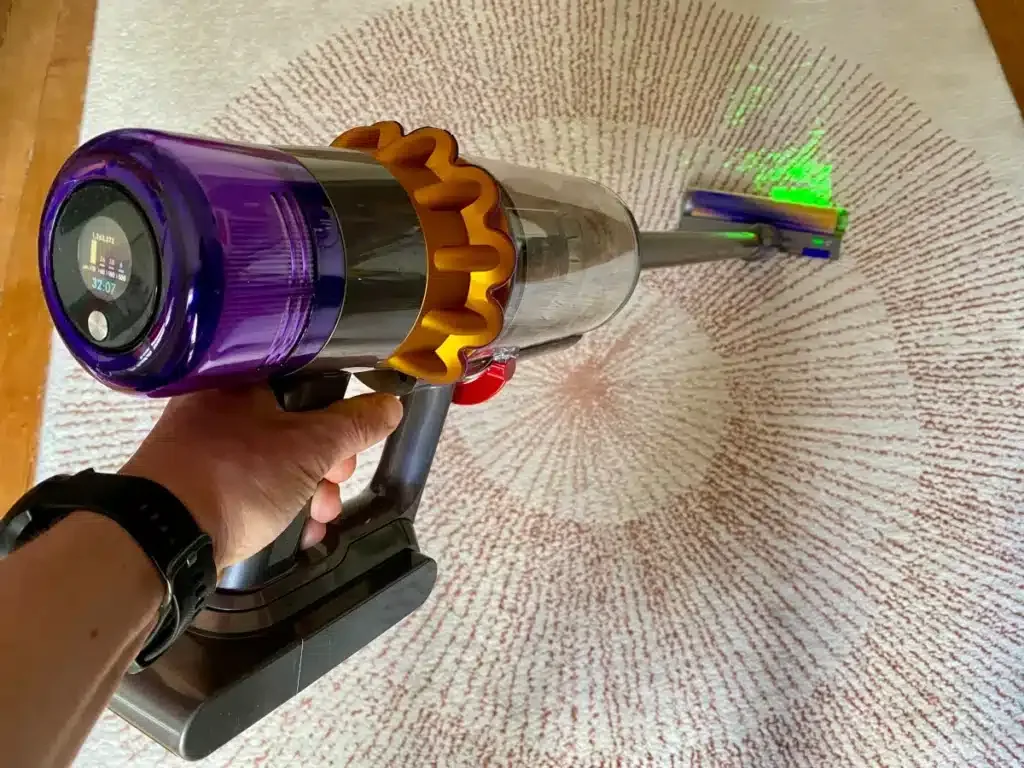
- The motor creates the low pressure that draws in air and debris. Digital motors spin very fast in a small space: Dyson quotes 125,000 revolutions per minute for the Hyperdymium motor of the V15 Detect.
- Separation splits the dust from the air. On cyclonic models, air spins through cones that throw particles into the bin by centrifugal force. According to Dyson, the V15 Detect has fourteen cyclones.
- Filtration traps fine particles before the air leaves the machine. A machine with fully sealed joints prevents dusty air from escaping before it reaches the filter.
- The cleaner head loosens the dirt. A motorised brush bar pushes stiff bristles into carpet fibres; a soft roller captures fine dust on hard floors without scratching them.
The battery powers the whole thing. Its capacity sets the runtime, but consumption varies enormously with the mode: at full power, the motor and motorised head drain the battery in a few minutes. That is why the claimed runtime must always be read together with the mode and the tool being used.
Stick, cylinder, robot or handheld
Before comparing models, you need to choose the right family. Each type of vacuum has a use where it excels and limitations that cannot be overcome.
| Type | Strengths | Limitations | For whom |
|---|---|---|---|
| Cordless stick | Ready in two seconds, easy to handle, converts to a handheld, no cable | Limited runtime at full power, medium-sized bin, weight held at arm’s length | Most flats and medium-sized houses |
| Cylinder | Continuous power, large bag or bin, weight rests on the floor | Slow to get out, cable to manage, awkward on stairs | Large homes, thorough weekly cleaning |
| Robot | Cleans on its own, effortless daily upkeep | Cannot do stairs, high corners or the sofa; needs a clear floor | Day-to-day upkeep alongside another machine |
| Handheld | Ultra compact, ideal for the car and crumbs | Cannot clean the floor of a whole room | Occasional back-up |
For many households, the winning combination is a powerful cordless stick and, possibly, a robot for daily upkeep. Our comparison cordless, cylinder or robot covers each situation in detail.
Our pick: the Dyson V15 Detect Absolute
Among high-end cordless stick vacuums, the Dyson V15 Detect Absolute is the one we recommend to a household that wants one machine to do everything. It does not win on every count: it is heavy for a stick vacuum and its price is high. What it does offer is a combination of strengths that is rare in a single machine.
- A laser that reveals dust on hard floors. Fitted to the soft roller head, a low-angle green beam brings out fine dust, hair and crumbs you could not see before. Dyson notes that its effectiveness depends on ambient light, the type of debris and the surface.
- A piezo sensor and an LCD screen. The sensor counts and sizes the particles picked up; the screen sorts them by size in real time and shows the mode and remaining runtime. In Auto mode, the machine adjusts its power to the amount of dust detected.
- A tangle-free Digital Motorbar head that removes hair and fur wrapped around the brush bar as you clean, and adapts power to the floor type in Auto mode.
- Whole-machine filtration that Dyson rates at 99.99% of particles down to 0.3 microns, with fourteen cyclones upstream.
- A click-in battery that comes out at the press of a button: a second battery, sold separately or included in the Absolute Extra version, doubles your cleaning time.
Official figures vary by version: Dyson France’s specification sheet gives 230 AW in Boost mode, while the more recent version claims 240 AW. The other figures are stable: up to 60 minutes in Eco mode on hard floors, 5 minutes in Boost, a 4.5-hour charge, a 0.76 L bin, about 3 kg and a 2-year guarantee. Our specifications page lists each value with its source.
The 10 criteria of a good stick vacuum
- Measured suction. Prefer a suction figure expressed in airwatts (AW) and measured to a standard, rather than the motor’s electrical power.
- Real runtime. Look at the runtime in the intermediate mode and with the motorised head, not just the maximum figure.
- A removable battery. A battery that comes out can be replaced at the end of its life and doubled up for large areas.
- The cleaner heads. A motorised head for carpets, a soft roller for hard floors and an anti-tangle system if you have pets or long hair.
- Filtration. A sealed machine with a fine filter releases cleaner air, which matters for people who are sensitive to dust.
- The bin. Its capacity, and above all how easy it is to empty: a bin you can empty without touching the dust is more pleasant.
- Weight and balance. A top-heavy machine tires the wrist, especially when cleaning up high.
- Handheld mode. Essential for the sofa, the car and the stairs.
- Storage and charging. A wall dock stores the machine and its tools and keeps it charged.
- Upkeep and parts. A washable filter, a removable brush bar, available spare parts and a clear guarantee.
Our guide how to choose a cordless vacuum cleaner covers each criterion in detail with the thresholds to remember.
Airwatts, watts, pascals, minutes: reading the figures
Stick vacuum specification sheets mix units that do not measure the same thing. Confusing them leads to misleading comparisons.
| Figure | What it measures | What it does not tell you |
|---|---|---|
| Watts (W) | The electrical power drawn by the motor | Suction efficiency: a power-hungry motor does not necessarily clean better |
| Airwatts (AW) | Suction power, combining airflow and low pressure | How the cleaner head behaves on a particular rug |
| Pascals (Pa) | Maximum low pressure, often measured with the inlet sealed | Airflow, without which strong low pressure picks up very little |
| Minutes | Runtime, almost always in the economy mode | Runtime in Boost mode or with the motorised head |
| Litres | Bin capacity | The amount actually usable before suction drops |
Dyson states that the V15 Detect’s suction is measured to the EN IEC 62885-4 standard, with a full bin, in Boost mode. That is a useful detail: a figure measured with a full bin is closer to real use than one obtained on a new, empty machine. Retailer listings give the V15 a power draw of 660 W, an electrical figure that tells you nothing about suction. Our article suction power and runtime explains these units in detail.
Vacuuming each type of floor
The right tool and the right mode do more for cleanliness than raw power. Here are the rules for each surface.
| Floor | Recommended head | Mode | Watch out for |
|---|---|---|---|
| Wood, laminate | Soft roller, ideally with laser | Eco or Auto | Avoid scratches: check the head is clean with no grit stuck in it |
| Tiles, polished concrete | Soft roller or motorised head | Eco or Auto | Go over the grout lines, where dust settles |
| Short-pile rugs | Motorised head | Auto | Move slowly, in both directions |
| Thick rugs, carpet | Motorised head | Auto, with occasional Boost | Boost drains the battery fast: keep it for dirty patches |
| Stairs | Handheld with combination tool | Eco or Auto | Work from top to bottom |
On a rug, the V15’s laser is of little use: it is designed for hard floors, and the motorised head does the work. Our guide vacuuming carpets, wood floors and tiles gives the method surface by surface.
Pet hair and long hair
Pet hair and long hair cause two problems: they wrap around the brush bar, which loses effectiveness, and they work their way into rugs and sofa fabric. A good stick vacuum for homes with pets therefore needs a powerful motorised head and a system that stops hair from wrapping.
The V15 Detect’s Digital Motorbar head includes anti-tangle technology that removes hair and fur from the brush bar as you clean. Recent versions also come with a conical tool, the Hair screw tool, for the sofa and the bed. With a pet, expect to empty the bin more often: hair fills 0.76 L quickly. Our guide cordless vacuums and pet hair covers the techniques that work.
Filtration and air quality
A vacuum does not just pick up dirt: it also releases the air it has drawn in. If that exhaust still contains fine particles, some of the dust goes back into the room. Two things matter: the fineness of the filter and how well the machine is sealed, so that all the air really passes through the filter.
For the V15 Detect, Dyson claims whole-machine filtration that captures 99.99% of particles down to 0.3 microns, tested to the EN 60312-1 standard. For people sensitive to dust, this matters as much as power. It does not replace airing the room and washing bedding regularly: even a very well-filtered vacuum only deals with what it picks up.
The 8-step method for effective cleaning
- Clear the floor: pick up toys, cables and socks before you start.
- Choose the head to suit the room: soft roller for hard floors, motorised head for rugs.
- Start high: skirting boards, sills and the tops of furniture with the right tool, so dust falls to the floor before you vacuum it.
- Start at the far end of the room and work back towards the door, so you do not walk on clean areas.
- Move slowly, in slightly overlapping strokes. Going too fast loses more than it gains.
- Keep Boost for stubborn areas: the entrance, under the table, around the dog’s bed.
- Finish with the corners using the crevice tool: along skirting boards, between pieces of furniture.
- Empty the bin and put the machine back on its dock so it is charged for next time.
Our user guide goes through each step with the Dyson V15 Detect.
Runtime and battery
Runtime is the most misunderstood criterion for stick vacuums. The headline figure refers to the most economical mode, often with a non-motorised tool. Dyson thus claims up to 60 minutes for the V15 Detect, specifying that this applies in Eco mode on hard floors; in Boost mode, the claimed runtime drops to 5 minutes. In between, Auto mode adjusts the power to the floor and the dust detected, and the runtime varies accordingly with those settings.
Buyer feedback points the same way: the battery is the most frequent complaint in negative reviews, with reported durations that vary widely depending on use. For a large home, the V15 has a simple solution: the battery clicks in and out, and a second battery doubles your cleaning time. A full charge takes 4.5 hours, according to Dyson.
A few habits help a lithium-ion battery last: store it in a room at a moderate temperature, avoid leaving it completely flat for long periods, and do not keep it in the sun or near a radiator. Our guide cordless vacuum batteries covers these points in detail.
Which vacuum for your home?
Answer a few questions: we suggest the most suitable type of machine and estimate your cleaning time, compared with the runtime Dyson claims for the V15.
A laser to see fine dust, a sensor that counts particles, a head that untangles hair and up to 60 minutes in Eco mode: enough to replace your cylinder vacuum.
- Laser
- Up to 60 min
- 0.76 L bin
Upkeep: bin, filter and cleaner heads
A poorly maintained stick vacuum quickly loses effectiveness. Three components need attention.
- The bin: empty it as soon as it reaches the max line. An overfilled bin reduces suction and can clog the cyclones.
- The filter: on the V15, it is washable. Follow the manual: rinse in cold water, without detergent, then let it dry completely before refitting it. A clogged filter reduces suction and can make the motor overheat.
- The cleaner heads: regularly remove threads and hair caught in them, and check that no grit is lodged under the soft roller, as it could scratch wood floors.
Our guide looking after a cordless vacuum gives the full maintenance schedule.
Mistakes to avoid
- Doing everything in Boost mode: the battery runs flat in a few minutes for a gain that is often pointless on hard floors.
- Waiting for the bin to overflow before emptying it.
- Forgetting the filter for months.
- Vacuuming liquids, fine plaster dust, ash or sharp debris: a household vacuum is not built for that.
- Using the motorised head on a fringed rug without care: the fringes get wrapped up.
- Leaving the machine off its dock: it will not be charged next time.
- Charging with a charger that is not the manufacturer’s.
Safety: the right habits
- Never look directly into the laser beam, and never point it at the eyes of a person or an animal.
- Never vacuum water, liquids, hot ashes or sharp objects.
- Only use the original charger and battery, and never leave a damaged appliance on charge.
- Fix the wall dock securely, out of reach of young children if possible.
- Unplug the charger and remove the battery before taking the cleaner head apart.
Who it is for, and who it is not for
The V15 Detect is for you if
- You want one machine for the whole home
- You have lots of hard floors and want to see fine dust
- You have a dog, a cat or long hair
- You are sensitive to dust and value good filtration
- You have stairs or a car to clean
It is not for you if
- You live in a studio flat with hard floors and no pets
- Your budget is tight: a simpler stick will do
- The weight in your hand bothers you, especially for ceilings
- You have a very large house and do not want a second battery
- You want a machine that also washes floors
Our detailed verdict looks at each of these profiles.
Buying on Amazon: what to check
The V15 Detect comes in several versions and colours, and there are many sellers. Before ordering, check:
- The exact version: Absolute, Absolute Extra (with a second battery), more recent versions with 240 AW and the Fluffy Optic head.
- The tools included, which vary from one version to another.
- The seller: Amazon or a third-party seller, and their returns policy.
- The guarantee: Dyson quotes 2 years on parts, labour and shipping; your statutory rights against the seller come on top of that.
- The price, which changes often: compare over a few days before buying.
In the UK, a distance purchase generally gives you a 14-day cancellation period under the Consumer Contracts Regulations, and the Consumer Rights Act protects you if the goods are faulty.
Check the price on AmazonDyson V15 Detect Absolute · new tabOur editorial method
We do not receive appliances from brands and we do not publish fake tests. Our guides are based on manufacturers’ specification sheets, tests published by independent laboratories and media, and an analysis of buyer reviews, which we summarise without copying them. Figures are always attributed to their source. The site is funded by Amazon affiliate links, which are flagged as such; they do not change the price you pay. More details on our affiliate disclosure page.
Frequently asked questions
What is the best cordless vacuum cleaner?
It depends on your home. For a household that wants a single machine that performs on every floor, with pets or lots of hard floors, we recommend the Dyson V15 Detect Absolute. For a small home with hard floors, a lighter and cheaper model is enough.
Can a cordless stick vacuum replace a cylinder vacuum?
Yes, for most flats and medium-sized houses, with a high-end model. In a very large house, plan a second battery or keep a cylinder for the big clean.
What runtime should I expect from a stick vacuum?
Look at the runtime for each mode. Dyson claims up to 60 minutes for the V15 Detect in Eco mode on hard floors, and 5 minutes in Boost. In mixed use with the motorised head, expect much less than the maximum.
What is the laser on the Dyson V15 for?
It makes fine dust visible on hard floors thanks to a low-angle green beam. It does not improve suction; it helps you see what is left. Dyson notes that its effectiveness depends on the light, the debris and the surface.
How long does a stick vacuum take to charge?
Usually several hours. Dyson quotes 4.5 hours for a full charge of the V15 Detect.
Is a stick vacuum suitable for pet hair?
Yes, with a motorised head and ideally an anti-tangle system such as the V15’s Digital Motorbar head. Empty the bin more often.
Is the Dyson V15 Detect heavy?
About 3 kg according to Dyson, which puts it among the heavier stick vacuums. You feel the weight mainly when cleaning up high.
Does the Dyson V15 wash floors?
No, the V15 Detect Absolute only vacuums. Dyson offers other versions with a wet cleaner head.
Should I buy a cordless or a corded vacuum?
A cordless stick suits most homes thanks to its speed and convenience. A corded cylinder still makes sense for very large areas of carpet or for anyone who prefers one long weekly session without worrying about the battery.
Is a cordless stick vacuum worth it for a small flat?
Yes: in a small home, its speed and the fact that it is always ready make the biggest difference. A light, mid-range model is often enough; a high-end model only makes sense with pets, rugs or a sensitivity to dust.
How often should I empty and clean a stick vacuum?
Empty the bin after every session or as soon as it reaches the max line, check the head every week and wash the filter as the manual says, generally once a month.
Can I use a stick vacuum on stairs?
Yes, and it is one of its strengths: remove the wand and use it as a handheld with the combination tool, working from the top step down.
Every day, in your home.
What the Dyson V15 Detect actually changes in a cleaning session.
Technical specifications.
- MotorHyperdymium, 125,000 rpm
- Suction (Boost)230 to 240 AW depending on version
- RuntimeUp to 60 min (Eco), 5 min (Boost)
- Charging time4.5 hours
- Bin0.76 L
- Filtration99.99% down to 0.3 µm
- WeightAbout 3 kg
- Dimensions126 × 26.6 × 25 cm
- Guarantee2 years
Dyson data (French spec sheet and product pages), cross-checked against retailer listings. Details and sources in our full specifications.
Dyson V15 Detect Absolute
- Hard-floor pick-up★★★★★
- Carpet pick-up★★★★★
- Pet hair and long hair★★★★★
- Real-world runtime★★★★★
- Comfort and weight★★★★★
- Value for money★★★★★
The Dyson V15 Detect Absolute is aimed at households that want one machine for everything, with top-tier suction and tools to see what is left on the floor.
It is not for everyone: its weight, its price and its mid-sized bin make it less relevant for a small flat with hard floors or for tight budgets. Our detailed verdict explains who it is for, and who it is not for.
Why it is our top pick
- The laser reveals fine dust on hard floors: you see what you pick up and what you miss.
- A piezo sensor and LCD screen that show the particles collected, the mode and the remaining runtime.
- A Digital Motorbar head that removes hair wrapped around the brush bar.
- Whole-machine filtration rated by Dyson at 99.99% of particles down to 0.3 microns.
- A click-in battery: a second battery doubles your cleaning time.
- Converts to a handheld vacuum for the sofa, the stairs and the car.
Limitations
- About 3 kg in the hand: heavier than many stick vacuums, especially for cleaning up high.
- The 60 minutes only apply in Eco mode on hard floors; in Boost, Dyson quotes 5 minutes.
- A 0.76 L bin that needs emptying often in a large home or with pets.
- A high price that varies a lot between periods and sellers.
Our guides to go further.
Choosing, vacuuming, maintaining: each guide explores one topic in depth, with practical methods and sources.
Cleaning you can finally see.
Laser · piezo sensor · up to 60 min in Eco · 0.76 L bin · 2-year guarantee. The price changes often on Amazon: check it, along with the seller, the exact version and the tools included, before you order.
Check the price on AmazonAffiliate link · new tab