Vacuuming carpets, wood floors and tiles: the right head and technique
You do not vacuum a wood floor the way you vacuum carpet, or tiles the way you vacuum a Berber rug. Choosing the right head, mode and technique for each floor noticeably improves the result, protects your floors and saves battery.
Contents
Principles common to all floors
Whatever the floor, a few rules improve the result:
- Clear the floor before you start: shoes, cables, toys, light mats. You vacuum faster and there is no risk of sucking up an object.
- Start high: dust from furniture and sills falls to the floor. Vacuum it first, and the floor last.
- Move slowly: a head that passes quickly leaves dust behind. A pace of about one step per second is enough.
- Use overlapping strokes, as when mowing a lawn.
- Start at the far end of the room and work back towards the door, so you do not walk on the clean area.
- Empty the bin before it is full: a full bin reduces suction.
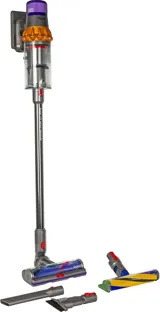
Choosing the head comes next. On a stick vacuum such as the Dyson V15 Detect, two main heads share the work: the soft laser roller for hard floors, and the Digital Motorbar for rugs and carpets. Our user guide explains how to change them.
Wood and laminate
Wood floors fear scratches. Small grains of sand and soil brought in on shoes act like sandpaper underfoot. Vacuuming them up regularly protects the varnish or oil.
The right head
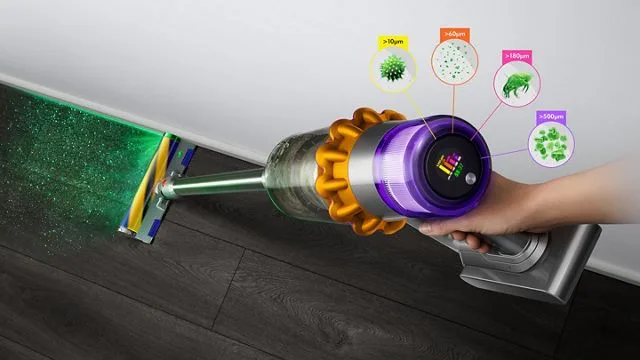
A soft roller, with a felt or fine nylon brush. It picks up fine dust and larger debris without scratching. Avoid stiff-bristle heads spinning fast, which can mark soft wood and flick debris around. On the V15, the soft roller carries the laser that lights the floor at a low angle and reveals fine dust.
The right mode
Eco mode is enough in most cases. Auto mode adapts power if there is a lot of dust. Boost is pointless on a clean wood floor and drains the battery.
The right technique
- Vacuum along the boards: dust settles between them.
- Follow the skirting boards, where dust bunnies gather.
- Go back where the laser still shows dust, without lingering elsewhere.
- Do not drag the head diagonally over a freshly oiled wood floor.
The laser and light: Dyson states that the laser’s effectiveness depends on ambient light, the debris and the surface. It reveals dust better in a slightly dark room or in the evening than in full sunlight.
Tiles and grout
Tiles are the easiest floor to vacuum. They are hard to damage, but their grout lines trap fine dust and crumbs.
- Head: the soft roller for dust and crumbs; the motorised head if debris is embedded in deep grout lines.
- Mode: Eco or Auto.
- Technique: go over once along the grout lines, then across them to empty the grooves.
- Corners: the crevice tool picks up what is left in corners and along the skirting boards.
Vacuuming does not replace washing. On a kitchen floor, the vacuum removes dust and crumbs, then a mop or a floor washer deals with greasy marks. Vacuuming before washing stops the dust turning into mud.
Large-format tiles with fine grout lines are quicker to clean; small mosaic tiles or deep, textured grout need a slower pass and sometimes the crevice tool along the lines. In bathrooms, watch out for damp floors: wait until they are dry before vacuuming.
Vinyl, linoleum and stone
Vinyl, linoleum and other resilient floors are treated like wood: soft roller, Eco or Auto mode, regular strokes. They are sensitive to scratches from large debris, which is why a soft roller that captures them without dragging them is useful.
Natural stone (travertine, slate, terracotta tiles) often has an uneven surface that traps dust in its hollows. The motorised head in Auto mode may then be more effective, provided the floor manufacturer allows it. If in doubt, try it first on an inconspicuous area.
Short-pile rugs and carpet
A rug’s fibres hold dust deep down. Suction alone recovers it poorly: you need a head that agitates and loosens it.
The right head
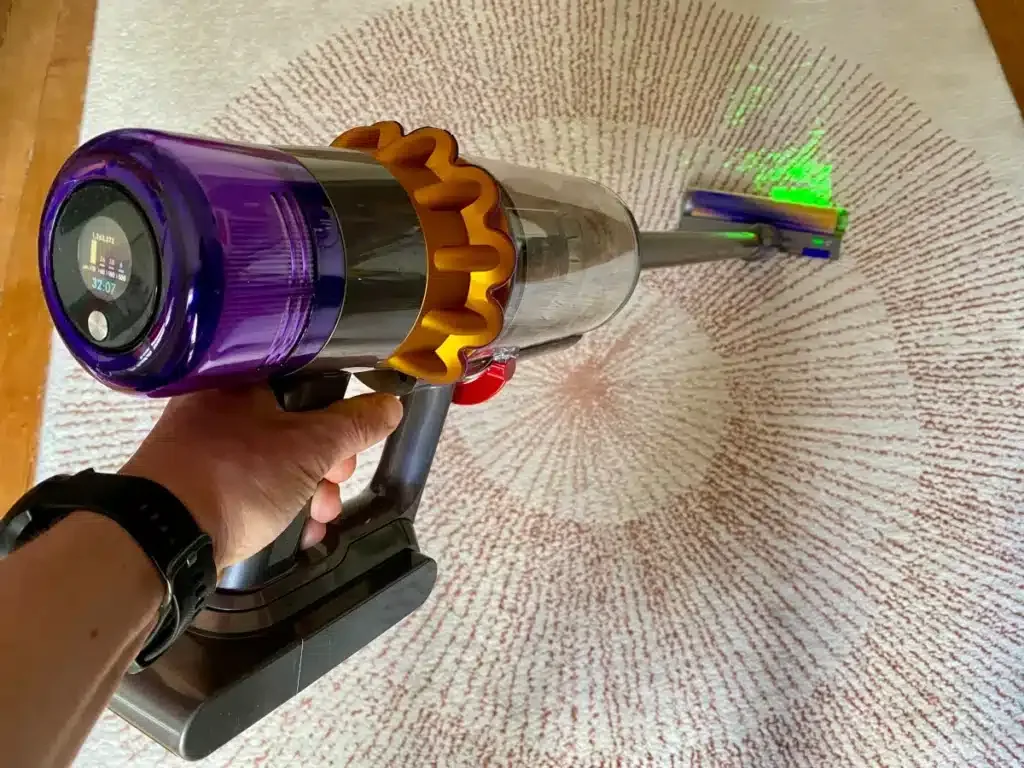
A motorised head, with a brush bar fitted with stiff bristles. It beats the fibres and releases the dust, which suction then carries away. On the V15, the Digital Motorbar detects the rug’s resistance and increases power in Auto mode, according to Dyson.
The right technique
- Move slowly: on a rug, the head needs time to work.
- Go over it once in one direction, then a second time in the opposite direction, to lift the fibres and reach both sides.
- Focus on high-traffic areas: entrance, in front of the sofa, under the table.
- Keep Boost for a patch of soil or a very dirty corner, for a few seconds only.
Fitted carpet needs a regular pass, at least once a week, to stop dust becoming embedded and fibres flattening in high-traffic areas.
Long-pile rugs and fringes
Shaggy rugs, Berber rugs and long-pile rugs are the hardest. Dust sinks very deep and the pile can slow the brush bar.
- Head: the motorised head, in Auto mode. If the brush bar struggles or stops, switch to handheld mode with a combination tool.
- Technique: vacuum with the pile, slowly, then against it.
- Turn the rug over from time to time and vacuum the back: dust that works through collects there, and on the floor underneath too.
- Fringes: do not vacuum them with the motorised head, which may wrap them up. Tuck them under the rug or use a tool without a brush bar, at low power.
Delicate and antique rugs
A hand-knotted rug, a kilim, an antique or silk rug cannot take a powerful motorised head. The stiff bristles of the brush bar can pull out fibres or tug at the knots. Use the soft roller or a tool without a brush bar instead, in Eco mode, with the pile. For a valuable rug, follow the advice of the maker or of a rug-cleaning specialist.
Moving from one floor to another
Most homes mix floor types: wood in the living room, a rug under the table, tiles in the kitchen. Changing heads at every transition is tedious. Two methods make the session easier:
- By floor type: do all the hard floors first with the soft roller, then all the rugs with the motorised head. You only change heads once.
- With the motorised head only: in a home mostly covered with rugs, the Digital Motorbar in Auto mode also handles hard floors, reducing its power when the floor is clear. You lose the help of the laser, but you save time.
Estimate the time needed for your home with our calculator.
Which vacuum for your home?
Answer a few questions: we suggest the most suitable type of machine and estimate your cleaning time, compared with the runtime Dyson claims for the V15.
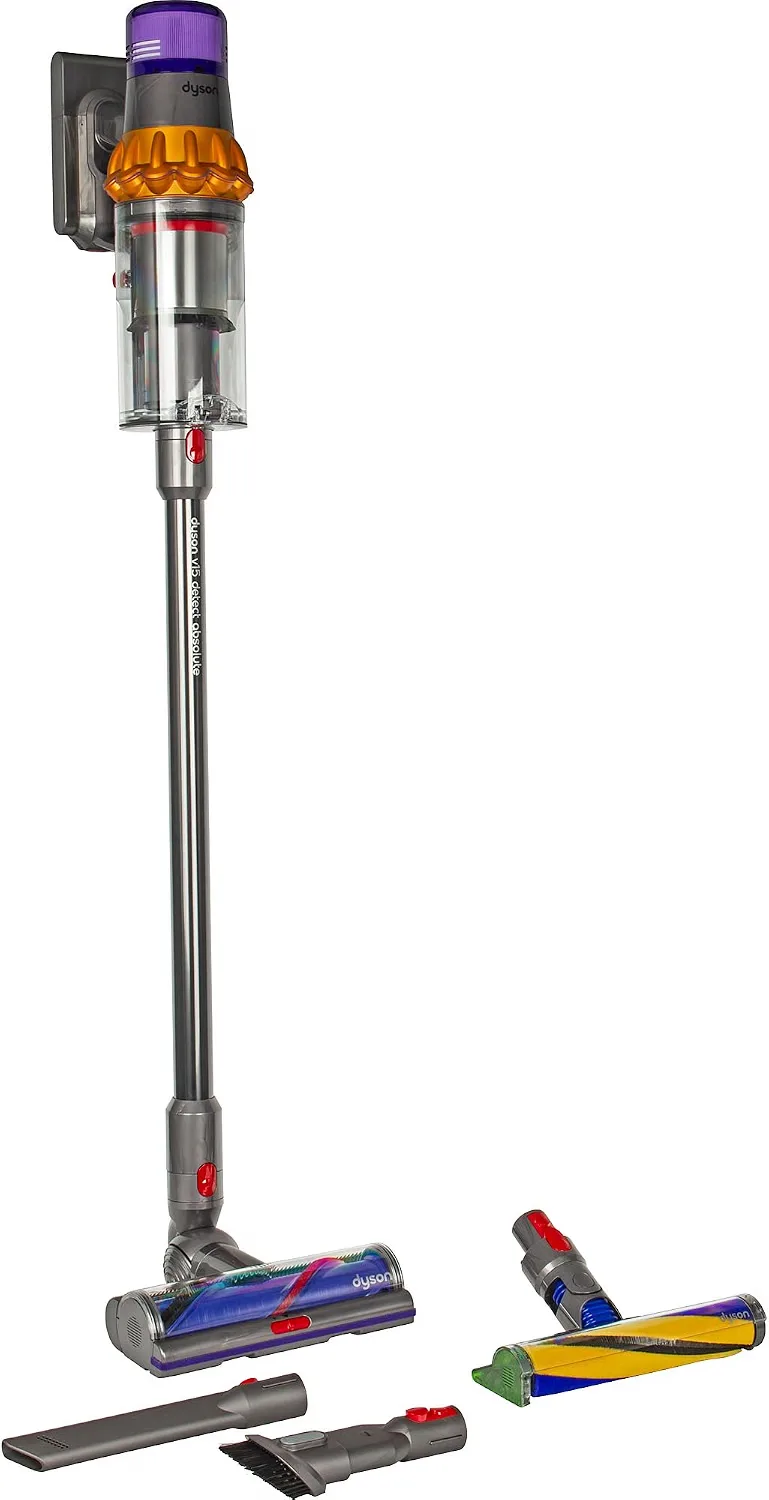
A laser to see fine dust, a sensor that counts particles, a head that untangles hair and up to 60 minutes in Eco mode: enough to replace your cylinder vacuum.
- Laser
- Up to 60 min
- 0.76 L bin
Stairs, mattress and car
Stairs
Switch to handheld mode, with the combination tool for the flat of the treads and the crevice tool for the corners. Start at the top and work down step by step, so that dust that falls is picked up on the next pass. Hold the banister with your other hand. On carpeted stairs, the mini motorised tool is more effective than the combination tool. Avoid balancing the machine on a step.
The mattress
A mattress collects dust, dead skin and dust mites. Vacuum it at every change of sheets, or at least once a month, with the mini motorised tool or a fabric tool, in Eco or Auto mode. Work in overlapping strips, without forgetting the sides and seams. Then let the mattress air for a few hours if possible.
The sofa
Remove the cushions, vacuum the base and the gaps with the crevice tool, then each cushion with the mini motorised tool or the fabric tool. On leather, use a soft brush, without pressing hard.
The car
Take out and shake the floor mats, then vacuum them separately with the motorised head. Inside the car, handheld mode and the crevice tool reach between the seats, into door pockets and under the seats. The mini motorised tool loosens sand and hair from fabric seats. A cordless stick proves far more practical here than a cylinder that has to be plugged in.
Curtains and ceilings
With the wand and the soft brush or combination tool, in Eco mode, vacuum curtains from top to bottom without pulling them tight. Cobwebs on the ceiling come off with the wand back on and a soft-bristle tool. This is where the weight of a stick with the motor at the top is felt most: take breaks.
How often to vacuum
The right rhythm depends on foot traffic, pets and allergies. As a guide: living areas and the entrance two to three times a week, bedrooms once a week, rugs in high-traffic areas more often than those in quiet rooms. With a pet or an allergy sufferer, increase the frequency. A short, regular pass is more effective than a long, infrequent session: dust does not become embedded.
To keep up this rhythm without thinking about it, tie vacuuming to a moment in the week: after Sunday lunch for the living areas, on sheet-changing day for the bedrooms. A stick vacuum hung on the wall, charged and ready, makes these passes so quick that they are no longer a chore.
Summary by floor
| Floor | Head | Mode | Key technique |
|---|---|---|---|
| Wood, laminate | Soft roller | Eco or Auto | Along the boards |
| Tiles | Soft roller | Eco or Auto | Along then across the grout lines |
| Vinyl, lino | Soft roller | Eco or Auto | Regular strokes without dragging debris |
| Uneven stone | Soft roller or motorised head | Auto | Test first on an inconspicuous area |
| Short-pile rugs, carpet | Motorised head | Auto | Slowly, in both directions |
| Long-pile rugs | Motorised head or tool | Auto | With the pile, then against it |
| Delicate rugs | Soft roller or tool without brush bar | Eco | With the pile, without lingering |
Mistakes to avoid
- Going too fast: the most common mistake. A head racing over the floor leaves dust behind.
- Staying in Boost: the battery runs down in a few minutes for little gain on a clean floor.
- Using the motorised head on a delicate rug or on fringes.
- Vacuuming a wet floor: a standard stick vacuum is not designed for moisture, which clogs the filter and can damage the machine.
- Neglecting skirting boards and corners, where dust bunnies gather.
- Forgetting the head: wrapped hair reduces its effectiveness. Our guide brush bar maintenance explains how to remove it.
For pet hair, specific techniques come on top of these: read our guide cordless vacuums and pet hair.
Frequently asked questions
Can I use a motorised head on a wood floor?
Yes if the vacuum maker and the floor maker allow it, but a soft roller is preferable: it captures fine dust better and cannot mark the wood.
How often should I vacuum a rug?
At least once a week, more often in high-traffic areas or with a pet.
Should I vacuum before washing the floor?
Yes: vacuuming first removes dust and crumbs, which would otherwise turn into mud with the water.
How do I vacuum a shaggy rug?
Slowly, with the motorised head in Auto mode, with the pile and then against it. If the brush bar struggles, switch to a tool without a brush bar.
Does the laser work on rugs?
No, it is designed for hard floors, where the low-angle light reveals fine dust.
How do I vacuum carpeted stairs?
In handheld mode with a mini motorised tool, from top to bottom, step by step.
Should I vacuum the mattress?
Yes, about once a month or at every change of sheets, with a fabric tool.
Should I vacuum a new rug differently?
New rugs often shed loose fibres for a few weeks. Vacuum them gently with the motorised head in Auto mode, empty the bin more often and check that fibres do not wrap round the brush bar.
Can I vacuum a sisal or jute rug?
Yes, with the soft roller or a tool without a brush bar, in Eco mode. These natural fibres are stiff and trap dust underneath: turn the rug over from time to time to vacuum the floor beneath.
Is a stick vacuum enough for fitted carpet throughout the house?
Yes with a high-end model and its motorised head, provided the area fits within the battery’s realistic runtime. For a large carpeted house, plan a second battery or clean in two sessions.
Cleaning you can finally see.
Laser · piezo sensor · up to 60 min in Eco · 0.76 L bin · 2-year guarantee. The price changes often on Amazon: check it, along with the seller, the exact version and the tools included, before you order.
Check the price on AmazonAffiliate link · new tab