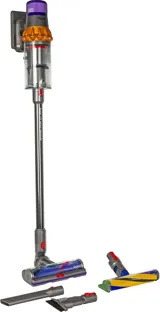
Cordless, cylinder or robot vacuum: which should you choose?
The cordless stick has taken the place of the cylinder in many homes, while the robot promises effortless cleaning. Each has its strengths and limitations. Here is a complete comparison, criterion by criterion, to find out which one suits you, or which combination.
Contents
Three ways to clean
Choosing between a stick vacuum, a cylinder and a robot is not just about choosing an appliance. It is about choosing a way of cleaning.
- The cylinder is the traditional vacuum: a body on wheels, a hose, a wand and a floor head. Powered from the mains or, more rarely, by battery, it vacuums powerfully for as long as you like. It is the tool for big weekly sessions.
- The cordless stick brings together motor, bin and battery in a machine you hold in one hand. It comes off the wall in two seconds. It is the tool for frequent, quick passes, and it can also handle the big clean if it is powerful enough.
- The robot vacuum covers the floor on its own, following a schedule, and goes back to charge on its base. It is the tool for effortless daily upkeep, keeping things clean between two proper sessions.
The right answer depends on your home, your floors, your time and your standards. It often involves combining two machines. Let us look at each criterion.
The comparison in one table
| Criterion | Cordless stick | Cylinder | Robot |
|---|---|---|---|
| Performance on hard floors | Very good (high end) | Very good | Good for upkeep |
| Performance on thick rugs | Good to very good (motorised head) | Very good | Variable, often limited |
| Runtime | Limited by the battery | Unlimited (corded) | Self-managed, automatic recharging |
| Speed of getting started | Instant | Slow (get out, plug in, unwind) | No effort at all |
| Corners, high places, stairs | Very good (handheld mode) | Good (hose) | Impossible up high and on stairs |
| Weight carried | 2 to 3.5 kg in the hand | Body pulled along the floor, light wand | None |
| Debris capacity | Small bin | Large bag or bin | Very small bin (unless self-emptying base) |
| Storage | Compact wall dock | Cupboard | Base on the floor |
| Noise | Medium | Medium to high | Low to medium, but longer |
| Consumables | Filter, battery eventually | Bags (bagged models), filters | Brushes, filters, base bags, battery |
This table shows the broad trends. Differences between models in the same family are sometimes greater than the differences between families. An entry-level stick does not clean like a high-end stick, and a premium robot has nothing in common with a basic one.
Cleaning performance
The cylinder, the historical benchmark
Running on mains power, the cylinder has no battery constraints. It can run a powerful motor for as long as needed and move a large volume of air. On thick carpet, a good cylinder with a turbo brush remains a benchmark for extracting deep-down dust.
The high-end stick, now at the same level
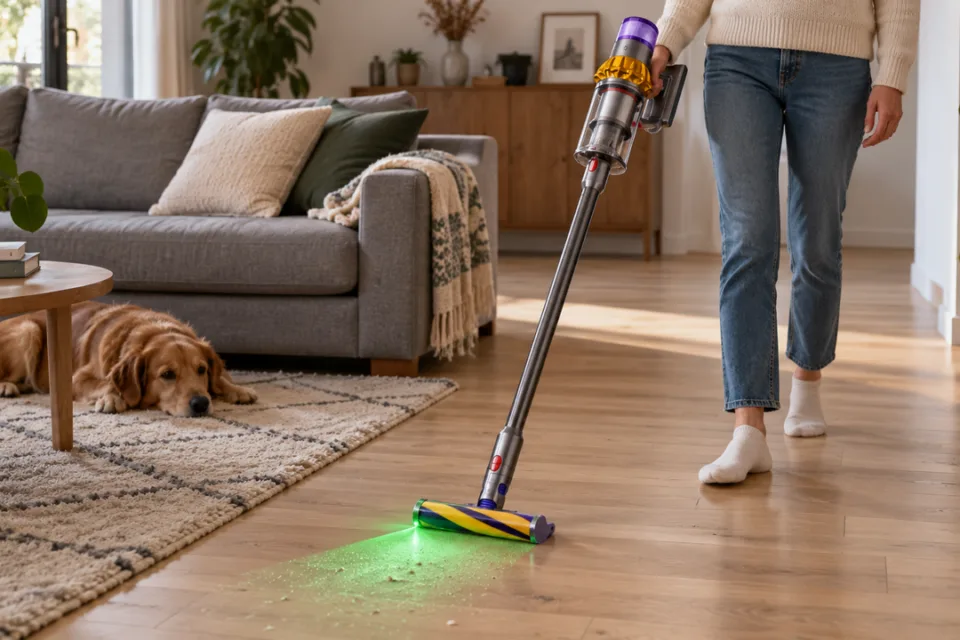
High-end cordless sticks have closed most of the gap. Their compact motors spin very fast, their motorised heads dig dust out of the fibres and their cyclones limit loss of suction. Dyson claims 230 to 240 AW in Boost for the V15 Detect depending on the version, measured with a full bin. On hard floors, the soft roller and the laser even give the stick an advantage: you can see the dust you are picking up. Independent tests place the best sticks on a par with good cylinders for home use.
The robot, champion of consistency
A robot has less suction than a stick or a cylinder: its motor and battery have to fit into a box a few centimetres high and run for an hour or more. Its strength lies elsewhere: it cleans every day. Dust picked up daily does not have time to become embedded. On hard floors, the result is excellent for upkeep. On thick rugs, it falls behind, and it does not replace a thorough pass from time to time.
In short: for pure power, the cylinder and the high-end stick are on a par in most homes. The robot wins on consistency, not on power.
Runtime and endurance
This is the main weakness of the cordless stick. Its battery limits the length of a session. For the V15 Detect, Dyson claims up to 60 minutes in Eco mode on hard floors and 5 minutes in Boost. In mixed use with the motorised head, the real duration lies somewhere in between, and depends on your floors.
For a flat, this is rarely a problem: 70 m² needs around twenty minutes of vacuuming by our estimates. For a large house with carpets, one charge may not be enough. A second battery or cleaning in two sessions solves the problem.
The corded cylinder has no time limit at all: it runs as long as it is plugged in. That is its main argument for very large areas. The robot manages its own runtime: when its battery runs low, it goes back to recharge, then picks up where it left off on models that support this.
Estimate your cleaning time with our calculator to find out whether a stick is enough.
Which vacuum for your home?
Answer a few questions: we suggest the most suitable type of machine and estimate your cleaning time, compared with the runtime Dyson claims for the V15.
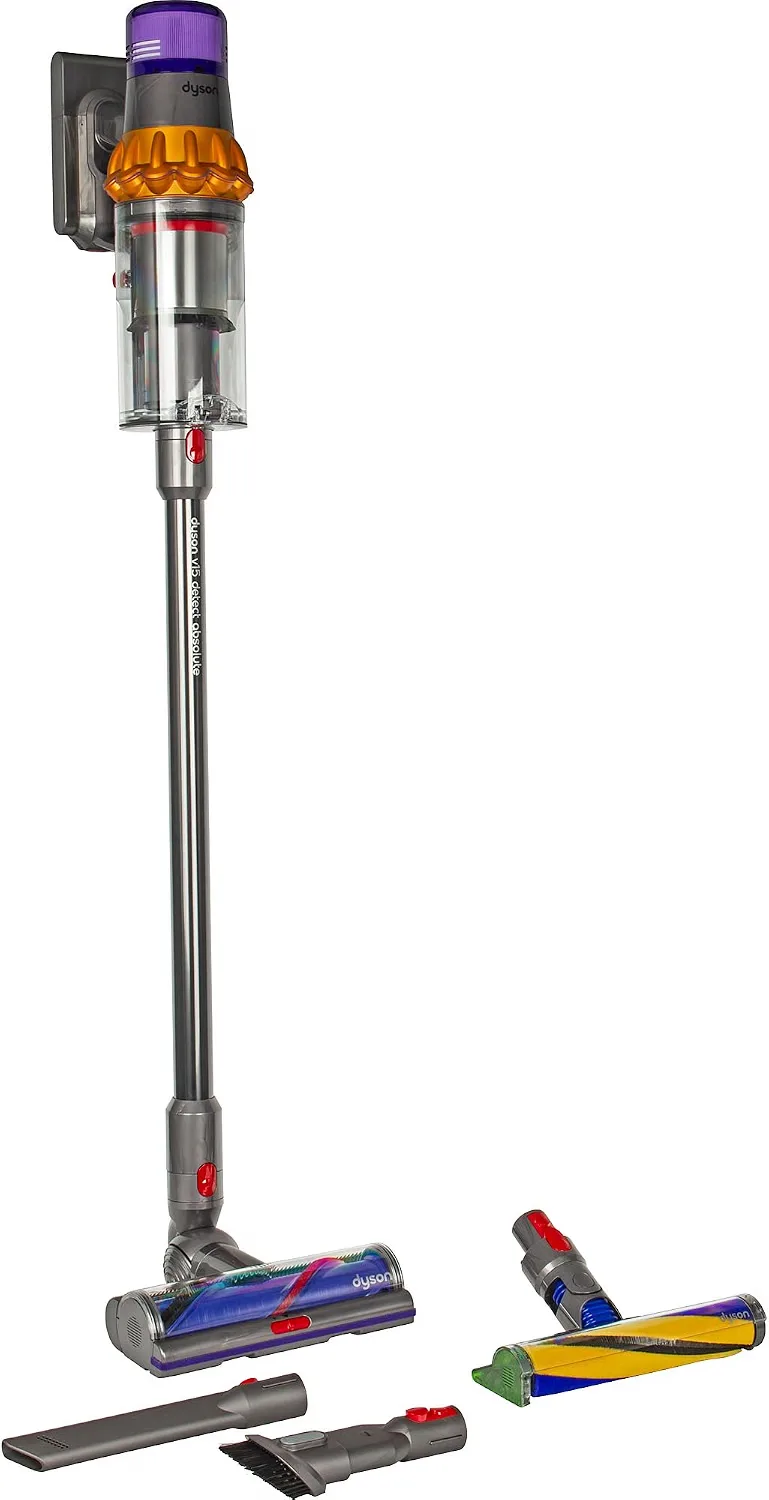
A laser to see fine dust, a sensor that counts particles, a head that untangles hair and up to 60 minutes in Eco mode: enough to replace your cylinder vacuum.
- Laser
- Up to 60 min
- 0.76 L bin
Everyday convenience
This is where the cordless stick has won households over. A vacuum you grab off the wall in two seconds gets used for crumbs after a meal, soil brought in on shoes, cat litter. The cylinder means getting the machine out of the cupboard, unwinding the cable, changing sockets from room to room, winding it back up and putting it away. So it is kept for the big weekly session, and you live with the crumbs in the meantime.
The robot goes further still: no effort at all. You do need to prepare the ground, though. Pick up cables, socks and toys, tuck in rug fringes, set no-go zones. A very cluttered home causes it problems. And you have to empty its bin, or its base’s bag, regularly.
The stick, for its part, means carrying the weight of the machine. About 3 kg for the V15 Detect, concentrated in the hand. On the floor, the head supports the machine. Up high, your arms do the work. The cylinder only makes you carry the wand and head, but you have to pull the body along behind you.
By surface
Wood, tiles, vinyl
All three machines do well. The stick with a soft roller excels with fine dust and large debris, and the V15’s laser helps you miss nothing. The robot keeps these floors perfectly clean day to day. The cylinder does very well, provided you use the right head so as not to scratch.
Short-pile rugs and thin carpets
The stick with a motorised head and the cylinder with a turbo brush are both effective. The robot handles routine upkeep correctly.
Thick rugs and long-pile carpets
The cylinder keeps a slight edge thanks to its endurance, and the high-end stick follows closely thanks to its motorised head and automatic power increase. The robot often struggles: some get stuck in long pile or fringes.
Our guide vacuuming carpets, wood floors and tiles details the techniques for each surface.
Corners, high places and stairs
The convertible stick wins clearly. Remove the wand and it becomes a handheld that goes everywhere: stair treads, sofa, car, shelves, window sills, cobwebs on the ceiling with the wand back on. The cylinder can do the same thanks to its hose, but on stairs you have to carry the body or wedge it on the steps. The robot does not climb stairs and does not clean above floor level. Nor does it clean corners perfectly, despite its side brushes.
Filtration and allergies
For allergy sufferers, filtration and hygienic emptying matter a great deal.
- Bagged cylinder: the bag seals the dust in, which makes emptying very hygienic. Combined with a good filter and a sealed machine, it is an excellent solution.
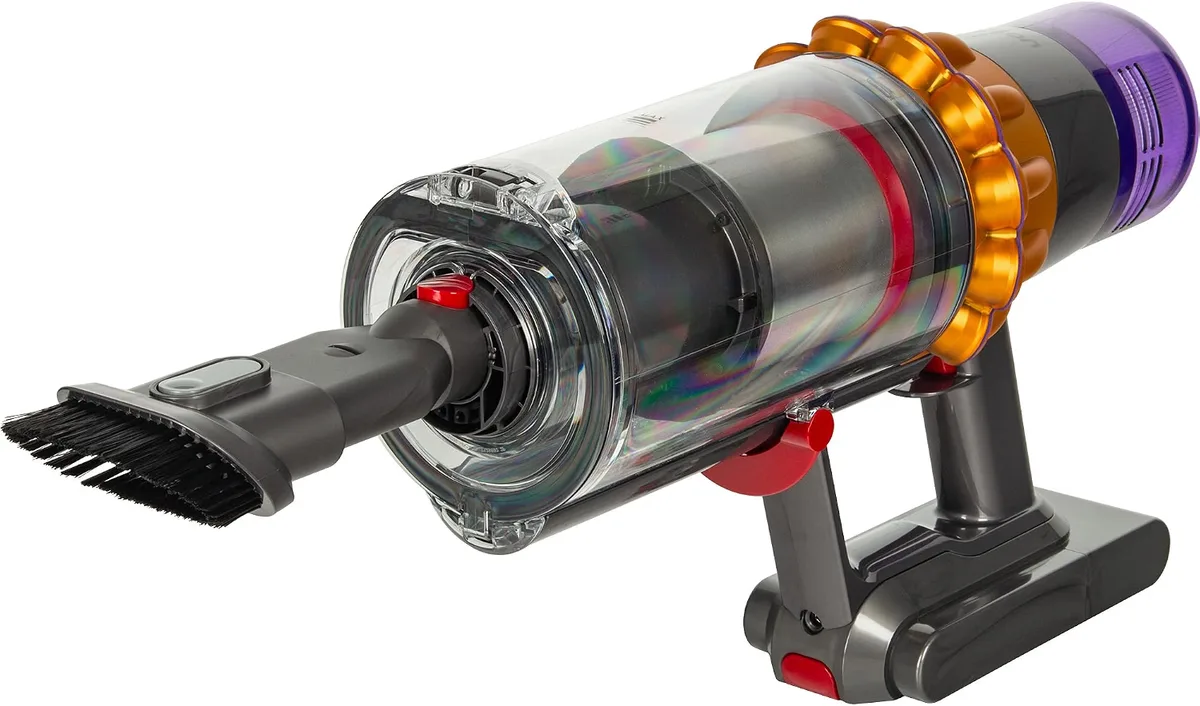
- Bin-type stick: you have to empty the bin by hand, which can put dust back into the air. The best models make up for it with whole-machine filtration: Dyson claims 99.99% of particles down to 0.3 µm for the V15 Detect.
- Robot: often decent filtration, and self-emptying bases that seal the dust in a bag. It vacuums while you are out, which reduces your exposure.
In every case, regular filter maintenance determines how effective it is. Our guide filter and brush bar maintenance explains how.
Noise
A stick and a cylinder make a comparable amount of noise, around 70 to 80 dB depending on the mode. Testers have recorded around 75 to 76 dB for the V15 Detect. The robot is quieter, but it runs for longer: that is why it is often scheduled for when you are out. In a flat, the stick has the advantage of short sessions.
Maintenance
| Machine | Routine maintenance | Periodic maintenance |
|---|---|---|
| Cordless stick | Empty the bin after each session | Wash the filter, check the heads, clean the bin |
| Cylinder | Change the bag when full (or empty the bin) | Change or wash the filters, check the head |
| Robot | Empty the bin (or the base bag) | Clean brushes and sensors, replace filters and side brushes |
The robot needs the most technical maintenance: its side brushes wear out, its sensors must stay clean, its wheels collect hair. The bagged cylinder is the simplest. The stick sits between the two.
Storage
The stick hangs on the wall on its dock, in a hallway or utility room, taking up less than 30 cm of width. It stays visible and charged, ready to use. The cylinder needs a cupboard for the body, the wand and the tools. The robot stays on the floor on its base, which has to be placed against a clear wall; self-emptying bases are bulkier.
Running costs
Beyond the purchase price, each machine generates costs over the years:
- Stick: few consumables (the filter is often washable), but a battery to replace after a few years, depending on use. Choosing a removable battery, as on the V15, makes replacement easier.
- Cylinder: bags to buy for bagged models, filters from time to time. Very little battery cost, since it runs on mains power.
- Robot: side brushes, main brush, filters, base bags and eventually the battery. It is often the machine with the highest maintenance costs.
Electricity consumption remains modest for all three. A stick recharges in a few hours, a cylinder uses power during the session, a robot recharges after each run.
Lifespan
A simple, robust cylinder can last many years: few electronic components, no battery. A cordless stick depends on its battery, its motorised head and its electronics. Its lifespan depends largely on whether these parts can be replaced. A robot has the most components that can fail: wheel motors, sensors, circuit board, battery.
In every case, check the availability of spare parts and the manufacturer’s repair policy. Dyson quotes a 2-year guarantee on parts, labour and shipping for the V15 Detect, on top of your statutory rights against the seller.
The right choice for your home
| Your situation | Our recommendation |
|---|---|
| Studio or small flat | A cordless stick, mid-range if the floors are hard |
| Family flat, mixed floors | An all-round or high-end cordless stick, on its own |
| Medium-sized house | A high-end stick, possibly with a robot for daily upkeep |
| Large house with carpets | A high-end stick with a second battery, or a cylinder plus a back-up stick |
| Dog or cat that sheds a lot | A stick with a tangle-free head, and a robot for daily upkeep |
| Allergy sufferer | A stick with certified filtration, or a sealed bagged cylinder |
| Little time, clear floors | A robot for daily upkeep and a stick for the corners |
| House on several floors | A convertible stick, more practical than a cylinder on the stairs |
| Difficulty carrying weight | A light cylinder or a robot, with a small stick for top-ups |
To refine your choice of stick, see our guide how to choose a cordless vacuum cleaner.
Combining two machines
For many households, the best solution is not one machine but two. Three combinations work particularly well.
Robot and stick
This is the most common combination. The robot cleans every day on clear floors and keeps things tidy. The stick steps in for corners, stairs, the sofa, the car and a thorough pass once a week. Each machine does what it does best, and you only carry the stick for a few minutes.
In practice, this pairing also spreads wear: the robot handles the repetitive daily work, which spares the stick’s battery and motor. Program the robot for when you are out, keep floors clear the evening before, and use the stick the rest of the time for targeted cleaning.
Cylinder and back-up stick
For very large houses with lots of carpet, the cylinder handles the big weekly session with no runtime worries. A small, light stick or a handheld picks up crumbs day to day.
Stick and second battery
This is not a second machine, but it is often the simplest way to stick with a single vacuum in a large home. The spare battery clicks in within seconds. The Absolute Extra version of the V15 Detect includes one.
Other types of vacuum
Stick, cylinder and robot cover most needs, but other appliances can complement or replace one of them.
The handheld vacuum
Small, light and cordless, it deals with crumbs on the table, car seats and the worktop. It does not replace any of the three main types for floors. A convertible stick, such as the V15 Detect, already includes this function: you just remove the wand.
The wet-and-dry stick
It vacuums and washes hard floors in a single pass, using a damp roller and a dirty-water tank. It is an interesting solution for large areas of tiles, kitchens or vinyl. It is not suitable for rugs, it is heavier than a standard stick, and its dirty-water tank needs cleaning after every use to avoid odours.
The wet-and-dry drum vacuum
This sturdy drum picks up liquids, rubble and building dust. It is the tool for the garage, the workshop and DIY projects. It is not designed for everyday cleaning of the home: bulky, noisy and awkward to handle.
The central vacuum system
Built into the house, it places the motor in a utility room and connects each room via wall inlets. Very powerful and quiet in living areas, it requires a costly installation and is mainly planned during a new build or a major renovation.
Common misconceptions
- “A cordless stick does not have enough suction.” That was true of the first models. Today’s high-end sticks rival good cylinders in most homes.
- “A robot does all the cleaning.” It keeps clear floors very clean, but it does not go on the stairs, on the sofa or into corners, and it struggles on thick rugs.
- “The cylinder is outdated.” It remains the most enduring and the simplest to maintain, with very hygienic emptying for bagged models. For a large area of carpet, it still makes perfect sense.
- “The more expensive, the better.” A high-end stick in a tiled studio flat adds almost nothing compared with a mid-range model.
- “A stick does not last ten minutes.” The real-world runtimes of good models easily cover a flat, provided you do not stay in maximum mode.
Five questions to decide
- How long does your cleaning take? If it fits within a stick’s realistic runtime, a stick is enough. If not, a second battery, a cylinder or a robot alongside.
- Are your floors clear? If so, a robot can take over daily upkeep. If your home is cluttered, it will be less useful.
- Do you have stairs or lots of fabric furniture? A convertible stick then becomes very practical.
- How much storage space do you have? A wall and a socket for the stick, a cupboard for the cylinder, a clear corner for the robot’s base.
- How much effort are you willing to put in? The robot needs none during cleaning, the stick a little, the cylinder more.
Your answers generally point to one main machine, and sometimes a second one alongside. Our calculator helps you answer the first question.
Switching from a cylinder to a stick
Have you always used a cylinder and are you considering a cordless stick? The switch is quick, but a few habits change.
- The rhythm: with a stick, you vacuum more often and for less time. Two or three short passes during the week replace the big Saturday session. Dust does not have time to build up.
- Emptying: no more bags to change, but a bin to empty every session. It takes a few seconds over the rubbish bin.
- The modes: you quickly learn to stay in Eco or Auto and keep maximum mode for stubborn areas, to spare the battery.
- The head: you change heads to suit the floor, or organise your session by floor type so you only change once.
- Storage: the wall dock becomes the machine’s fixed home, where it stays charged and ready.
Many households that make the switch keep their old cylinder for a few months, just in case, then part with it when they realise they never take it out. Others keep it for a big quarterly session or for a garage. Both approaches make sense: it all depends on the floor area and the rugs. If you keep your cylinder, check its filter and bags before putting it away, so it is ready on the day you need it.
Where the Dyson V15 Detect fits
The V15 Detect Absolute is designed to replace a cylinder. Its claimed power, its tangle-free motorised head, its automatic power adjustment and its whole-machine filtration let it handle the big clean, while its stick format and conversion into a handheld make it practical for quick passes. The laser adds an advantage that neither the cylinder nor the robot offers: seeing fine dust on hard floors.
Its limitations are those of the family: real-world runtime in mixed use, the weight in your hand and a bin smaller than a cylinder’s. For a medium-sized home, it can be your only vacuum. For a very large area, pair it with a second battery or a robot. Our full review and our verdict will help you decide.
Frequently asked questions
Is a cordless stick as effective as a cylinder?
High-end models are, in most homes. The cylinder keeps the advantage of endurance on very large areas of carpet.
Can a robot vacuum replace a stick?
For daily upkeep of clear floors, yes. For corners, stairs, the sofa and thick rugs, you need another machine.
Which vacuum for a large house?
A high-end stick with a second battery, or a cylinder for the big session and a stick or robot for day to day.
Which vacuum for allergy sufferers?
A machine with certified whole-machine filtration and hygienic emptying: a sealed bagged cylinder or a well-filtered high-end stick.
Is a cordless stick more expensive to run?
It has few consumables, but its battery will need replacing after a few years. The robot is often the most expensive to maintain.
Can you vacuum stairs with a cylinder?
Yes, with the hose, but you have to wedge the body on the steps. A stick that converts to a handheld is more practical.
Does a robot vacuum damage wood floors?
Not in normal use, provided its wheels and brushes are kept clean: a trapped grain of sand can mark a soft wood floor.
Can a robot be scheduled while you are out?
Yes, that is in fact its main advantage. Prepare the floor before leaving: cables, shoes and toys should be put away.
Is a cordless stick suitable for an older person?
Yes, if it is light enough and you stay on the floor. For cleaning up high, the weight in the hand can be a problem: a lighter model or one with the motor at the bottom is then preferable.
Should I keep my old cylinder?
If your stick covers your whole home, it will hardly be used any more. It can remain useful for a very large area of carpet or for the garage.
Which machine for a 40 m² home?
A cordless stick is more than enough, mid-range if the floors are hard and there are no pets.
Does a robot vacuum work in a home with pets?
Yes for daily hair pick-up on clear floors, which really helps during moulting. Avoid it if accidents are possible, and empty its bin often: hair fills it quickly.
Is a bagged cylinder better for allergies than a stick?
A sealed bagged cylinder offers the most hygienic emptying. A high-end stick with whole-machine filtration comes close, provided you empty the bin outdoors or into a sealed bag.
Which is quieter, a stick or a cylinder?
They are comparable in their usual modes. The stick has the advantage of short sessions; the robot is quieter but runs for longer.
Can a stick vacuum and a robot share the same charging spot?
Not physically, but it helps to plan them together: the stick’s wall dock and the robot’s base both need a nearby socket, ideally in a central, easily accessible place.
Cleaning you can finally see.
Laser · piezo sensor · up to 60 min in Eco · 0.76 L bin · 2-year guarantee. The price changes often on Amazon: check it, along with the seller, the exact version and the tools included, before you order.
Check the price on AmazonAffiliate link · new tab