How to choose a cordless vacuum cleaner: the complete guide
Watts, airwatts, minutes of runtime and lasers: stick vacuum listings all look alike and muddy the waters. Here are the criteria that really matter, with clear benchmarks, the traps to avoid and the right machine for every home.
Contents
Start from your home, not from the figures
There is no best cordless stick vacuum in absolute terms. There is a machine that suits your floor area, your floors, your pets, your stairs and the way you like to clean. Before comparing specifications, answer five simple questions. They rule out half of the models straight away and stop you paying for features you do not need.
- How much floor area do you vacuum in one go? A 25 m² studio and a 140 m² house do not need the same battery.
- Which floors dominate? Wood, tiles, vinyl, short-pile rugs, thick carpet: the useful head and power change.
- Do you have a dog or a cat? Hair wraps around brush bars and fills the bin very quickly.
- Do you have stairs, a car, a fabric sofa? Handheld mode and its tools become essential.
- Will the stick be your only vacuum? If so, it needs enough power and endurance to replace a cylinder.
Write down your answers. They will serve as your reading grid for each criterion below. Our calculator does this in a few seconds: it estimates your cleaning time and compares it with the claimed runtime.
The families of stick vacuums
Very different machines are sold under the same name. Telling them apart stops you comparing a back-up stick with a machine designed to replace a cylinder.
| Family | For whom | Limitations |
|---|---|---|
| Light back-up stick | Small areas, everyday crumbs, alongside another vacuum | Modest power and runtime, not well suited to rugs |
| Mid-range all-rounder | Flats, mostly hard floors, regular use | Head less effective on carpet, less advanced filtration |
| High-end convertible stick | Whole home, pets, rugs, households that want one machine | High price, heavier |
| Low-motor stick | People who want less weight in the hand | Less practical as a handheld and for the tops of furniture |
| Stick with emptying station | Allergy sufferers, people who hate emptying the bin | Bulky station, bags to buy |
| Wet-and-dry stick | Hard floors that need regular washing | Heavier, dirty-water tank to clean, useless on rugs |
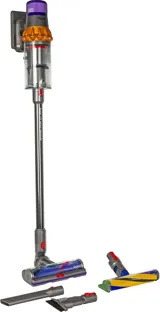
The Dyson V15 Detect Absolute belongs to the third family: a high-end convertible stick, with the motor at the top, which turns into a handheld vacuum. Our full review analyses it in detail.
Criterion 1: suction power
This is the first figure people look at, and the most misunderstood. Three figures appear on product listings, and they do not measure the same thing.
Electrical watts
They show the power drawn by the motor. A 660 W motor, like the one in the V15 Detect, uses more power than a 300 W motor, but that does not guarantee it cleans twice as well. The efficiency of the airflow path, the sealing, and the design of the head and cyclones matter as much as raw power.
Airwatts (AW)
The airwatt combines airflow and the low pressure created at the inlet. It is the most meaningful figure for comparing suction, provided you know how it was measured: empty or full bin, in maximum mode or not, at the motor inlet or at the end of the wand. Dyson claims 230 AW in Boost for the original V15 Detect and 240 AW for the recent version, measured with a full bin to the EN IEC 62885-4 standard.
Pascals (Pa)
Some manufacturers publish low pressure in pascals or kilopascals. It tells you how hard the machine “pulls” on a sealed opening, but ignores airflow. A machine can show strong low pressure and weak airflow, and therefore pick up light, bulky debris poorly.
Practical benchmark: for a stick vacuum that has to replace a cylinder in a home with rugs, look for a model whose manufacturer publishes high airwatts measured in realistic conditions, and check the results of an independent test on carpet. Our article suction power, airwatts and runtime explains these units in detail.
Above all, remember that maximum power is only used for a few minutes. Day to day, you will vacuum in an intermediate or automatic mode. The power actually available in that mode matters more than the peak figure in large print.
Criterion 2: real-world runtime
Runtime is the second big promise on product listings and the first source of disappointment among buyers. The reason is simple: the headline figure almost always corresponds to the most economical mode, with the least demanding head, on a hard floor.
For the V15 Detect, Dyson claims up to 60 minutes in Eco mode on hard floors and 5 minutes in Boost. Between the two, Auto mode adapts power to the floor and the dust: the runtime then depends on your home. Independent tests generally show that a high-end stick used with its motorised head in an intermediate mode lasts considerably less than the maximum figure.
To find out whether the runtime is enough for you, think in terms of cleaning time:
- allow about 15 seconds per m² on hard floors, a little more on mixed floors, considerably more on carpet;
- add a margin if you have a pet;
- compare the total with about 70% of the maximum claimed runtime, to keep something in reserve.
A 70 m² flat with mixed floors needs around twenty minutes of vacuuming: a high-end stick covers that easily. A 150 m² house with carpets often goes beyond what one charge covers comfortably. A second battery, or cleaning in two sessions, then becomes the solution.
Which vacuum for your home?
Answer a few questions: we suggest the most suitable type of machine and estimate your cleaning time, compared with the runtime Dyson claims for the V15.
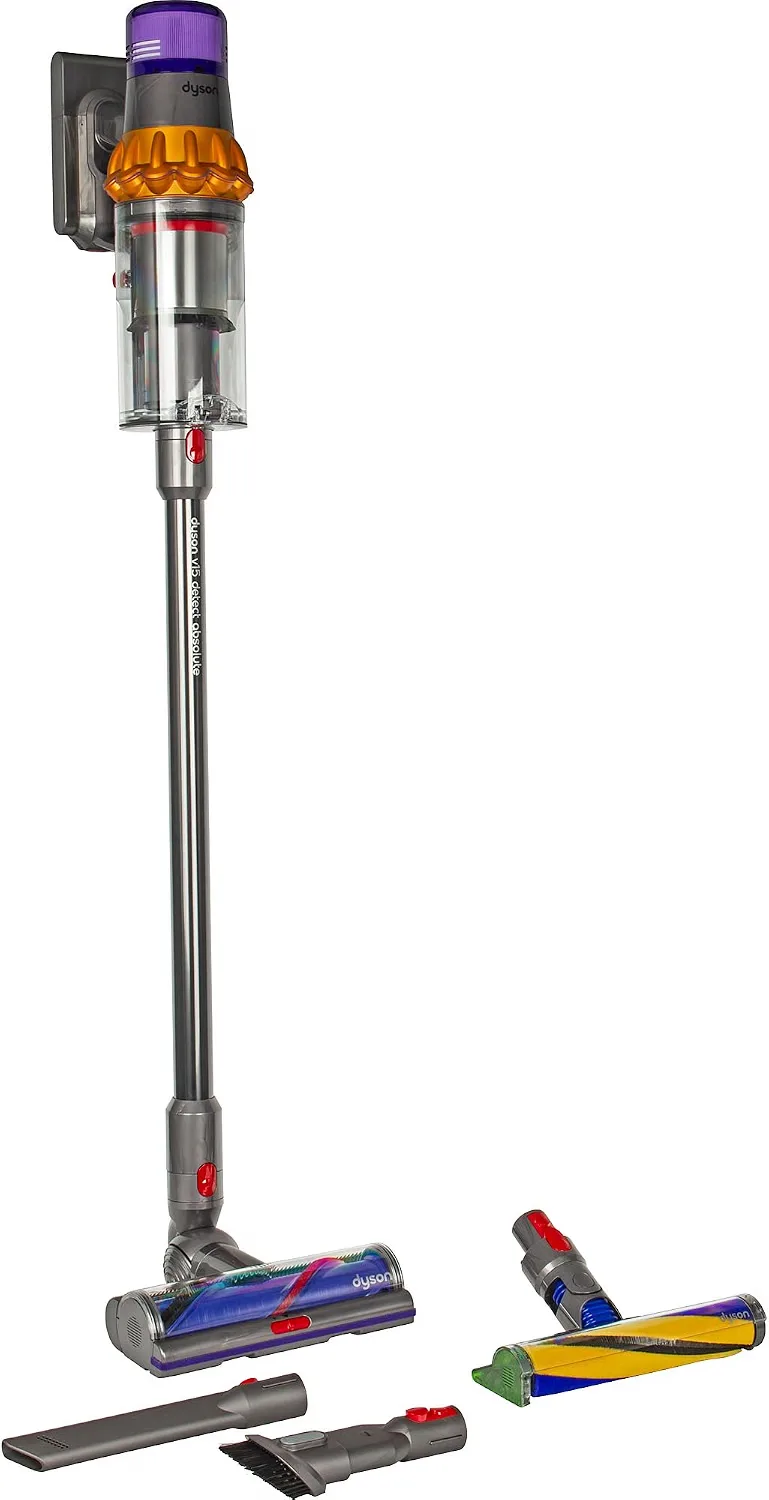
A laser to see fine dust, a sensor that counts particles, a head that untangles hair and up to 60 minutes in Eco mode: enough to replace your cylinder vacuum.
- Laser
- Up to 60 min
- 0.76 L bin
Criterion 3: the battery
The battery determines runtime, but also the lifespan of the machine. Three points deserve your attention.
Removable or built in
A removable battery can be replaced without tools when it ages, and lets you add a second one. A built-in battery means taking the machine apart, or even going through after-sales service. On the V15 Detect, the battery clicks in: a real advantage for keeping the machine going longer.
Charging time
It ranges from about 3 to 5 hours depending on the model. The V15 Detect needs 4.5 hours according to Dyson. If you vacuum every day, this is not a problem: the machine recharges overnight on its dock. If you want two sessions in one day, a second battery is essential.
The charge indicator
A simple light gives an approximate level. A screen that shows the minutes remaining, as on the V15, tells you whether you will finish the room before you start. It is a real everyday comfort.
To find out everything about lifespan, charge cycles and good habits, read our article battery and lifespan.
Criterion 4: the cleaner heads
The head does as much as the motor. A powerful motor behind an unsuitable head leaves dust in a rug’s fibres or pushes large debris around on tiles.
The motorised head
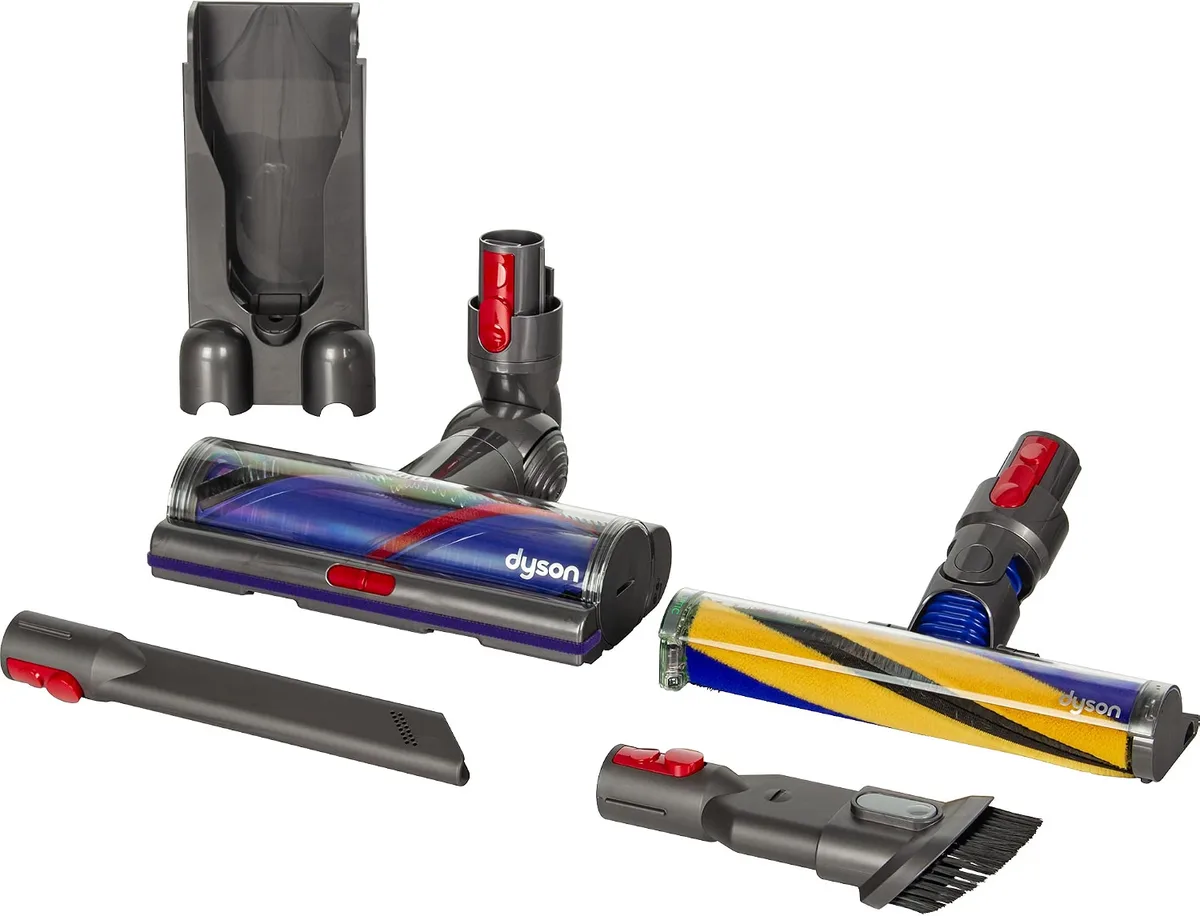
It has a brush bar driven by a motor, fitted with stiff bristles that dig the dust out from deep in the fibres. It is the essential head for rugs and carpets. On recent models, combs or a conical brush bar remove hair during use: that is the case with the V15’s Digital Motorbar.
The soft roller
Fitted with a felt or soft nylon roller, it is designed for hard floors. It picks up both fine dust and larger debris without scratching wood. On the V15, it carries the laser that lights up the floor.
The single “all floors” head
Some sticks come with only one head, said to work everywhere. It keeps costs down, but it rarely does as well as a specialised head on each type of floor.
Our advice: if you have rugs and hard floors in similar amounts, choose a model supplied with both types of head. If you have pets, the anti-tangle function becomes a priority. Our guide vacuuming carpets, wood floors and tiles details the right head for each surface.
Criterion 5: filtration
A vacuum draws in dusty air and releases it back into the room. The quality of the filtration determines what that exhaust air contains. For someone allergic to dust mites, pollen or pet dander, it is a major criterion.
- HEPA filter: a filter that traps the vast majority of very fine particles. The term alone is not enough: check the class stated and above all whether the performance applies to the filter alone or to the whole machine.
- Whole-machine filtration: the measurement takes account of leaks between the bin, the cyclones and the filter. For the V15 Detect, Dyson claims 99.99% of particles captured down to 0.3 microns, to the EN 60312-1 standard.
- Washable filter: practical and economical, provided you dry it completely before refitting.
A filter only stays effective if it is looked after. Our guide filter and brush bar maintenance explains how.
Criterion 6: the bin
A stick vacuum has no bag: dust goes into a clear bin that you empty by hand. Its capacity ranges from about 0.3 L for small models to nearly 0.8 L for the largest. The V15 Detect has 0.76 L.
Usable capacity is lower than gross capacity: you need to empty at the max line to keep good suction. With pet hair, which takes up a lot of room, the bin fills fast, sometimes in a single room. Look at the emptying mechanism too: a bin that opens from the bottom in one movement, over the rubbish bin, limits contact with the dust. A system that pushes the debris out of the bin means you never have to put your fingers in.
Criterion 7: weight and balance
A stick vacuum generally weighs between 2 and 3.5 kg. The V15 Detect is quoted at around 3 kg. That figure alone does not tell the whole story: the way the weight is distributed matters as much.
- Motor at the top: all the weight is in your hand. On the floor, the head supports the machine and you feel almost nothing; up high or in handheld mode, your arms work harder. In return, converting it into a handheld is instant.
- Motor at the bottom: your hand carries less, but handheld mode is less practical and the machine fits less easily under low furniture.
If you have wrist or shoulder pain, try the machine in a shop if possible, or choose a lighter model, even if it means losing a little power.
Criterion 8: noise
A stick vacuum generally produces between 70 and 85 dB depending on the mode. Testers have recorded around 75 to 76 dB for the V15 Detect. Noise varies a great deal with the mode: Boost is noticeably louder. If you vacuum early in the morning or late in the evening in a flat, look at the noise level in the intermediate mode, when it is published, and favour Eco mode.
Criterion 9: the tools
The tools make the difference between a stick that only does floors and a machine that replaces all the others. The most useful are:
- Combination tool (nozzle and brush): furniture, shelves, window sills;
- Crevice tool: skirting boards, corners, grooves, between cushions;
- Mini motorised tool or hair tool: sofa, bed, car seats, the dog’s bed;
- Soft brush for delicate surfaces: screens, keyboards, ornaments;
- Angled or reach adaptor: tops of wardrobes, ceilings, cobwebs.
The contents of the box vary depending on the version and the seller. Check the exact list before ordering, and compare like for like.
Criterion 10: sensors, screen and laser
High-end stick vacuums now include so-called smart features. Some are genuinely useful, others are mostly marketing.
- Automatic power adjustment: the machine detects the floor type or the amount of dust and adjusts the motor. Very useful so you do not have to manage the modes, and to save battery on a clean floor. On the V15, this works in Auto mode with the Digital Motorbar.
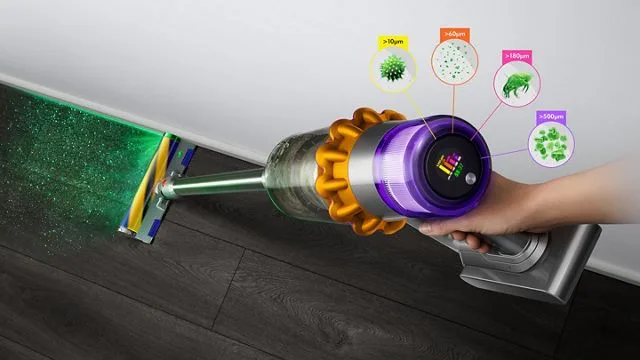
- Particle counting: a piezoelectric sensor measures the size and number of particles picked up and displays them. It is interesting for seeing when an area is clean, less so for the cleaning itself.
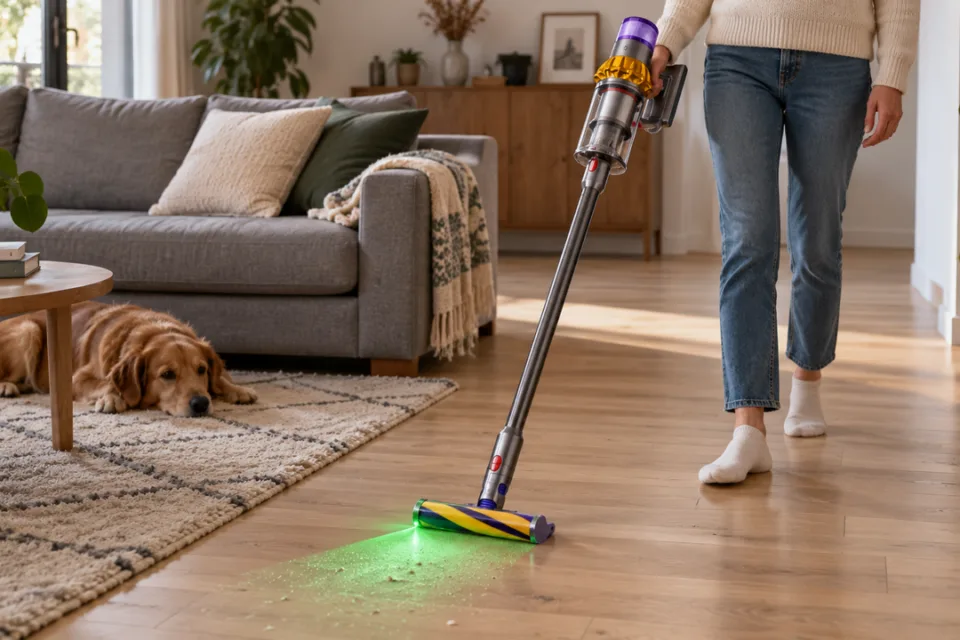
- Floor lighting: a laser or low-angle LEDs reveal fine dust on hard floors. Effective in a room that is not too bright, useless on rugs.
- Screen: remaining runtime, mode, maintenance alerts. A welcome comfort.
Criterion 11: storage and charging
A vacuum that is easy to get out is a vacuum that gets used. Most stick vacuums are stored on a wall dock that charges them: you need a socket nearby and a wall you can drill. Some models stand up on their own or are stored on a floor stand, which is practical for tenants. Self-emptying stations take up more room but spare you emptying the bin by hand.
Think about the charger too: can the battery be charged outside the machine? Can the charger be plugged straight in without the dock? These details count if you cannot drill.
Criterion 12: reliability, guarantee and parts
A high-end stick vacuum is a significant outlay. It should last several years. Three points help make sure it does:
- The guarantee: your statutory rights protect you against the seller if the product is faulty. Some manufacturers add a commercial guarantee; Dyson quotes 2 years on parts, labour and shipping for the V15.
- Availability of parts: batteries, filters, heads and brush bars should be available separately. Check the manufacturer’s spare parts policy before you buy.
- Buyer feedback: reviews that mention faults and the quality of after-sales service are more informative than reviews written on the day of delivery. Our summary of reviews on the V15 covers them.
The right machine for your profile
| Your profile | What you need |
|---|---|
| Studio or small flat, hard floors | A light mid-range stick, soft roller, modest runtime is enough |
| Family flat, mixed floors | An all-round stick with motorised head and soft roller, removable battery |
| House with rugs and carpets | A powerful high-end stick, automatic adjustment, a second battery if the area exceeds about 100 m² |
| Dog or cat | Tangle-free head, fabric tool, good filtration, large bin |
| Allergy sufferer | Certified whole-machine filtration, hygienic emptying, filter that is easy to maintain |
| House on several floors | A stick that converts to a handheld, light if possible |
| Arm or wrist pain | A light model, or one with the motor at the bottom |
To find out whether a stick is enough or whether you need a cylinder or a robot, see our comparison cordless, cylinder or robot. For pets, our guide pet hair goes further.
What you get at each price level
Stick vacuum prices cover a wide range and change often, with promotions and new generations. Rather than figures that would quickly go out of date, here is what you generally get at each level of the range.
Entry level
Here you find light sticks, often with a built-in battery, a single head and a modest claimed runtime. They are fine for picking up crumbs, keeping a kitchen tidy or cleaning a small studio with hard floors. Their head struggles on rugs, their filtration is basic and the bin is small. They make good back-ups alongside another vacuum.
Mid-range
This is the most crowded category. The machines offer a removable battery, a motorised head sometimes paired with a soft roller, decent tools and enough runtime for a flat. Some already include a screen or automatic power adjustment. It is often the best value for money for a home with mostly hard floors and no pets.
High end
Here you pay for suction power, specialised tangle-free heads, certified whole-machine filtration, sensors, a detailed screen and often a longer guarantee. These machines, like the Dyson V15 Detect Absolute, are designed to replace a cylinder throughout the home. They make sense if you vacuum often, have rugs or pets, or suffer from allergies.
Our advice: start from your real needs, then choose the lowest level of the range that covers them. A more expensive machine does not clean a tiled studio any better. Conversely, skimping on the head or the battery when you have a dog and carpets quickly leads to frustration.
The most common buying mistakes
Disappointed buyers tell similar stories. Most disappointments come from a gap between the intended use and what the machine can do, not from a fault in the product.
- Choosing on maximum runtime. You buy “60 minutes” and discover 20 to 30 minutes with the motorised head on carpet. Always think in terms of the intermediate mode.
- Underestimating the weight up high. On the floor, 3 kg goes unnoticed. For the tops of wardrobes or cobwebs, your arms tire quickly.
- Forgetting pet hair. A head without an anti-tangle system means cutting wrapped hair after every session.
- Neglecting storage. Without a socket near the planned spot, the dock ends up in a cupboard and the stick no longer gets charged.
- Thinking a stick washes. A stick vacuum vacuums. To wash tiles, you need another appliance or a mop.
- Ignoring maintenance. A filter that is never washed causes suction to drop and can make the machine cut out. That is not a fault, it is forgotten maintenance.
- Buying without checking the tools. Two offers with the same name may contain different heads. Read the exact contents of the box.
Avoiding these mistakes only takes a few minutes of thought before you buy. That is exactly what the checklist below is for.
One last tip: keep your shortlist to two or three models that tick all your essential boxes, then compare them on independent tests and on long-term buyer feedback. Beyond that, differences between good machines are often smaller than the differences between your own floors and habits.
The traps in product listings
Some phrases come up again and again. Knowing them helps you avoid nasty surprises.
- “Up to 60 minutes”: in the lowest mode, with the least demanding head, on a hard floor. Ask yourself how long the machine lasts with the motorised head.
- “25,000 Pa of power”: maximum low pressure, often measured at the motor inlet, with no indication of airflow. It cannot be compared with airwatts.
- “500 W motor”: electrical consumption, not efficiency.
- “HEPA filter”: the class and the sealing of the machine matter more than the word.
- “No loss of suction”: true as long as the filter is maintained and the bin emptied in time.
- “2-in-1” or “3-in-1”: check that each function is genuinely effective, not just present.
- Crossed-out prices: the reference price is sometimes theoretical. Compare the prices actually charged over a few weeks instead.
The checklist before you buy
- I have estimated my cleaning time and compared it with the runtime in the intermediate mode, not just the maximum.
- The battery is removable and replaceable.
- The heads supplied match my floors.
- The head resists tangling if I have pets or long hair at home.
- Filtration is claimed for the whole machine if I have allergies.
- The weight suits me, including in handheld mode.
- I have a spot for the dock, near a socket.
- Filters, heads and batteries are available separately.
- I have checked the exact list of tools included.
- I have read buyer reviews written after several months of use.
Frequently asked questions
What is the most important criterion when choosing a stick vacuum?
The match between real-world runtime and your cleaning time, then a head suited to your floors. Maximum power comes after that.
How many airwatts do I need?
To replace a cylinder in a home with rugs, look for a high-end model that publishes high airwatts measured in realistic conditions. For back-up use on hard floors, less power is enough.
Is a stick vacuum suitable for allergy sufferers?
Yes, if it offers certified whole-machine filtration and hygienic emptying, and if the filter is maintained regularly.
Do I need a motorised head?
Yes, as soon as you have rugs, carpets or pets. For hard floors only, a soft roller is enough.
Is the laser a gimmick?
Not on hard floors, where it reveals fine dust and helps you vacuum better. It adds nothing on rugs and is less effective in bright light.
What is the minimum runtime to aim for?
Enough to cover your cleaning time with a margin of about 30% in the intermediate mode. Our calculator helps you estimate it.
Should I choose a stick with a self-emptying station?
It is worth it if you are allergic or hate emptying the bin. In exchange, the station takes up space, makes noise when emptying and uses bags that must be bought regularly.
Is a cheap stick vacuum a false economy?
Not for a small home with hard floors. It becomes one if you have pets, carpets or a large area: a weak head and a short runtime quickly lead to frustration.
Can I trust star ratings on shopping sites?
Use them as a trend, not a measurement. Read reviews written after several months of use and look for recurring points, such as runtime or after-sales service.
Cleaning you can finally see.
Laser · piezo sensor · up to 60 min in Eco · 0.76 L bin · 2-year guarantee. The price changes often on Amazon: check it, along with the seller, the exact version and the tools included, before you order.
Check the price on AmazonAffiliate link · new tab