Cordless vacuum batteries: runtime, charging and lifespan
The battery is the heart of a cordless stick vacuum: it sets the length of your sessions and, often, the lifespan of the machine. Here is how it works, what makes runtime vary, the right habits to preserve it and the right moment to replace it.
Contents
How the battery works
Almost all cordless stick vacuums use lithium-ion batteries. They are made up of several cylindrical cells connected in series, protected by a casing and managed by a circuit board. This board monitors the voltage, temperature and current of each cell, to prevent overcharging, deep discharge and overheating.
Lithium-ion has become the standard because it stores a lot of energy in a small weight and can deliver a high current, which a powerful motor needs. It has no memory effect: you can recharge it at any time, without waiting for it to run flat. On the other hand, it ages over time and with charge cycles, and it is sensitive to heat.
Volts, capacity and energy
Three figures sometimes appear on batteries:
- Voltage, in volts (V): it depends on the number of cells in series. A higher voltage lets a powerful motor run on less current. Dyson gives 29.4 V for the V15 Detect’s battery on its specification sheet.
- Capacity, in milliamp-hours (mAh): the amount of charge stored. At the same voltage, more mAh means more runtime.
- Energy, in watt-hours (Wh): voltage multiplied by capacity. It is the fairest figure for comparing two batteries with different voltages.
These figures are not enough to predict runtime: that depends above all on the consumption of the motor and the head, and therefore on the mode and the floor. A high-capacity battery in a very powerful machine can last less time than a small battery in an economical one.
Claimed runtime
Manufacturers state a maximum runtime, measured in the most favourable conditions: the most economical mode, a non-motorised head or simple tool, a hard floor, a new battery, room temperature. For the V15 Detect, Dyson claims up to 60 minutes in Eco mode on hard floors and 5 minutes in Boost mode.
This maximum value is not false, but it rarely corresponds to real use. It is mainly useful for comparing machines with each other under identical conditions. The figure that is really useful, runtime in the intermediate mode with the motorised head, is rarely published. Independent tests give an idea of it.
What reduces real-world runtime
| Factor | Effect | What to do |
|---|---|---|
| Powerful mode | Much higher consumption; 5 min in Boost on the V15 | Stay in Eco or Auto, Boost occasionally |
| Motorised head | Its own motor draws power | Soft roller on hard floors |
| Rugs and carpets | The brush bar works harder, power rises in Auto mode | Allow more time, or a second battery |
| Clogged filter, full bin | The motor works harder for the same airflow | Empty and wash regularly |
| Cold | A cold battery delivers less energy | Store the machine indoors |
| Ageing | Capacity falls over the charge cycles | Replace the battery when it is no longer enough |
To estimate whether your battery covers your cleaning, use our calculator, which compares your cleaning time with the claimed runtime.
Which vacuum for your home?
Answer a few questions: we suggest the most suitable type of machine and estimate your cleaning time, compared with the runtime Dyson claims for the V15.
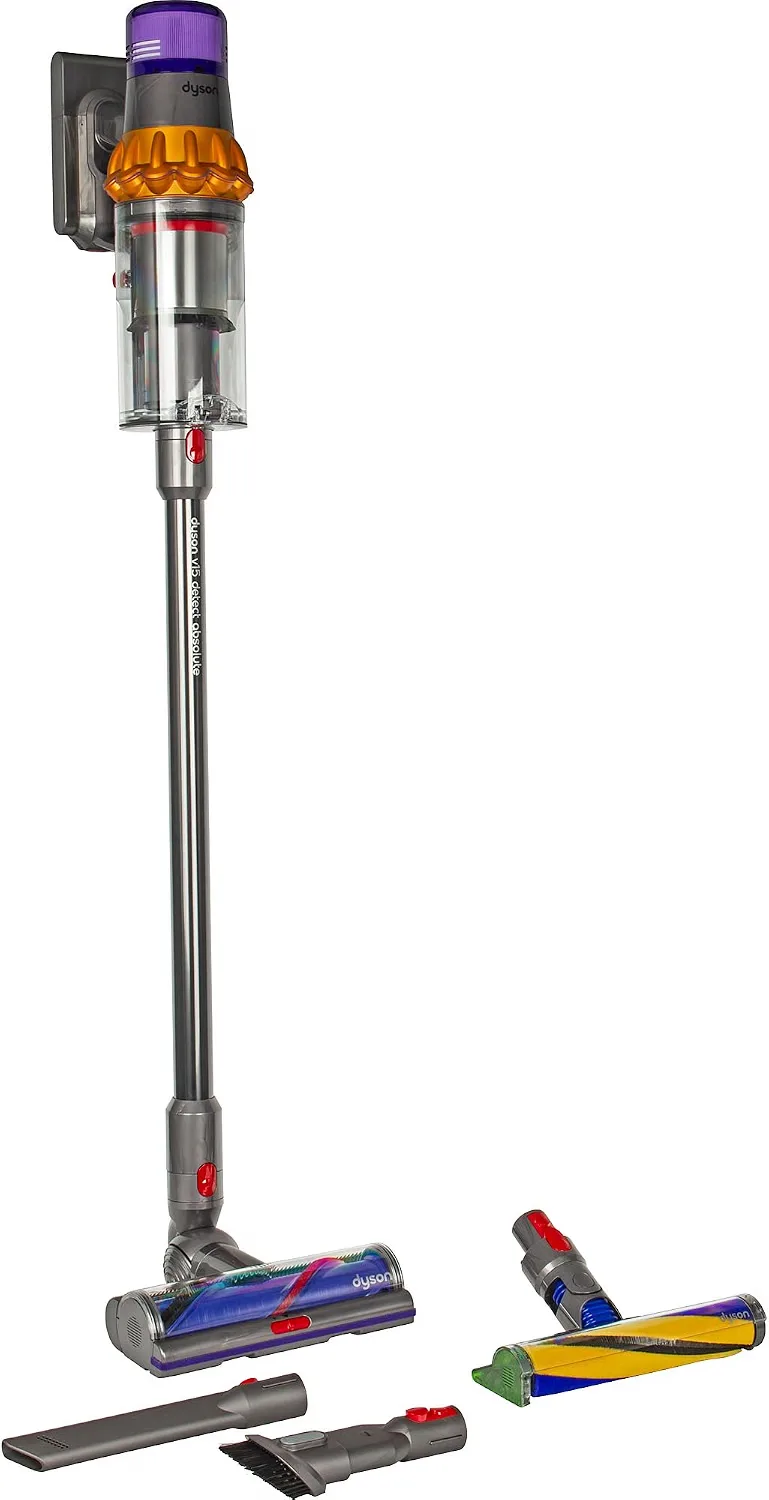
A laser to see fine dust, a sensor that counts particles, a head that untangles hair and up to 60 minutes in Eco mode: enough to replace your cylinder vacuum.
- Laser
- Up to 60 min
- 0.76 L bin
Charging
A stick vacuum recharges in about 3 to 5 hours, depending on the model and the capacity of the battery. Dyson quotes 4.5 hours for the V15 Detect. Charging is done on the wall dock or by plugging the charger straight into the battery.
A few practical points:
- You can hang the machine back up after every use: the electronics stop charging when the battery is full.
- A battery that is hot after a session in Boost can wait to cool down before charging: some machines delay charging automatically.
- The light or the screen shows the charge level. On the V15, the screen shows the remaining runtime in real time.
- A partial charge is enough for a quick pass: there is no need to wait for a full charge.
Lifespan
A lithium-ion battery gradually loses capacity. This ageing has two causes: the number of charge and discharge cycles, and the passage of time, accelerated by heat. After a few years of regular use, a battery may offer only part of its original runtime.
Vacuum manufacturers rarely publish a guaranteed number of cycles. Real lifespan depends a lot on use: a battery used daily in Boost and kept in a hot garage in summer will age much faster than a battery used in Auto mode and stored at room temperature. With reasonable household use, a battery lasts several years.
The sign to watch: it is not the battery’s age, it is its runtime. As long as it covers your cleaning, there is no need to change it.
Good habits to preserve it
- Keep it at room temperature: no direct sunlight, no radiator, no overheated conservatory, no freezing garage.
- Use Auto or Eco mode day to day and keep Boost for stubborn areas.
- Maintain the filter and the head: a clogged machine makes the motor work harder and drains the battery faster.
- Avoid leaving it flat for weeks: hang the machine back on its dock after use.
- If you will be away for a long time, store it partly charged, as many lithium-ion battery makers recommend.
- Use the original charger, matched to the battery’s voltage and current.
- Do not drop it: an impact can damage the cells.
Our guide cordless vacuum maintenance covers the care of the whole machine.
Do you need a second battery?
A second battery doubles the cleaning time available without waiting for a recharge. It is useful in three situations:
- a large area, where your cleaning time exceeds what one charge comfortably covers;
- lots of rugs or a pet, which call for the motorised head and a more powerful mode;
- several sessions a day, without time to recharge in between.
It is only useful if the battery is removable, which is the case on the V15 Detect, whose battery clicks in. The Absolute Extra version of the V15 includes a second battery. For a small area, one battery is more than enough, and the second would age without being used.
When and how to replace it
When
Replace the battery when its runtime no longer covers your cleaning, even though the machine is well maintained (clean filter, untangled head, clear wand). Replace it immediately if it shows a defect: swelling, cracking, unusual heat, a smell.
How
- Removable battery: it unclips or unscrews depending on the model. On the V15 Detect, it clicks out without tools.
- Built-in battery: replacing it means taking the machine apart; it is better to go through after-sales service or a repairer.
- During the guarantee: contact the manufacturer first, as the battery may be covered.
Choose an original battery or a compatible battery of recognised quality, with the same specifications. Very cheap batteries of unknown origin may offer less capacity than stated, and can be a safety risk.
Safety and recycling
Lithium-ion batteries are safe in normal use, but they store a lot of energy. A few rules are essential:
- never open a battery or try to repair it;
- stop using a battery that is swollen, cracked or unusually hot;
- do not expose it to high heat or to water;
- never throw it out with household rubbish: take it to a shop or a household waste recycling centre, at a battery collection point.
Shops that sell batteries generally offer a take-back point for used batteries. Recycling recovers some of the metals they contain.
Battery myths
- “You must run the battery flat before recharging it.” False for lithium-ion, which has no memory effect. Repeated deep discharges actually wear it out faster.
- “Leaving the machine on its dock damages the battery.” No: the electronics cut off charging when the battery is full. It is how manufacturers intend it to be stored.
- “A higher-capacity battery always lasts longer.” Not if the machine uses more power. Runtime depends as much on the motor, the head and the mode as on the battery.
- “The first charge must last 24 hours.” That was true of older technologies. For a lithium-ion battery, simply follow the manual, which generally recommends a full charge before first use.
- “A battery that is fading is faulty.” A gradual loss of runtime is normal with age. Check the filter and the head first: a dirty machine uses more power.
- “All compatible batteries are the same.” Their quality varies a great deal. A cheap battery may offer less than its stated capacity and be a safety risk.
Remembering these few principles is enough to get the best from your battery for years, without complicated precautions.
Winter and summer
Temperature has a direct effect on the battery. In winter, a machine kept in an unheated garage or conservatory can lose some of its runtime, and some batteries refuse to charge below a certain temperature to protect themselves. Bring the machine into a heated room and let the battery return to room temperature before charging it.
In summer, avoid leaving the machine in the sun behind a window, in a car or near a heat source. Heat speeds up the ageing of lithium-ion cells far more than the number of cycles. After a long session in Boost, the battery is hot: let it cool down before putting it back on charge if the machine does not do this automatically.
The rule is simple: keep the vacuum where you would feel comfortable yourself, neither too hot nor too cold.
If you take the vacuum to a holiday home or in a car, do not leave it in a boot in the sun. Transport it with a partly charged battery, and let it reach the temperature of the room before its first charge on arrival. These precautions take a few minutes and can add months to the battery’s life.
The Dyson V15 Detect battery
| Figure | Claimed value | Source |
|---|---|---|
| Voltage | 29.4 V | Dyson France specification sheet |
| Maximum runtime | Up to 60 min in Eco mode, on hard floors | Dyson France specification sheet |
| Boost runtime | 5 min | Dyson France specification sheet |
| Charging time | 4.5 hours | Dyson France specification sheet |
| Type | Removable, click-in | Dyson |
| Second battery | Included in the Absolute Extra version | Dyson |
The V15’s screen shows the remaining runtime in real time, depending on the mode and the head. It is a real comfort to know whether you will finish the room. Real-world runtime in mixed use with the Digital Motorbar remains well below the maximum 60 minutes: it is one of the criticisms that comes up in buyer reviews, according to our summary of reviews. For the other specifications, see our specifications explained.
Frequently asked questions
How long does a stick vacuum battery last?
Several years with reasonable household use. It depends on the number of cycles, heat and the mode used.
Can I leave the vacuum on charge all the time?
Yes, the electronics stop charging when the battery is full. It is how manufacturers intend it to be stored.
Why does runtime fall over time?
Lithium-ion cells lose capacity with cycles and time, faster in heat. A clogged filter also reduces runtime.
Is a compatible battery a good idea?
Only if it comes from a recognised maker and matches the original specifications. During the guarantee, choose the original battery.
Where should I dispose of a used battery?
At a battery collection point, in a shop or at a recycling centre, never with household rubbish.
Can the battery be charged outside the machine?
On models with a removable battery, the charger can often be plugged straight into the battery. Check your model’s manual.
Why does the battery not charge in winter?
Some batteries block charging when they are too cold, to protect themselves. Let it return to room temperature.
Does Boost mode wear the battery out faster?
It puts more strain on it and makes it heat up. Occasional use is planned for; constant use speeds up its ageing.
Can I buy a battery with a higher capacity than the original?
Only if the manufacturer offers one for your model. A non-original battery with a higher stated capacity may be incompatible with the machine’s electronics and may void the guarantee.
Does fast charging damage the battery?
Use only the charger supplied, which is matched to the battery. The battery’s electronics manage the charge; third-party fast chargers are not recommended.
Cleaning you can finally see.
Laser · piezo sensor · up to 60 min in Eco · 0.76 L bin · 2-year guarantee. The price changes often on Amazon: check it, along with the seller, the exact version and the tools included, before you order.
Check the price on AmazonAffiliate link · new tab