Cordless vacuum calculator: which model and how much runtime?
Enter your floor area, your floor types, whether you have pets or stairs and how often you clean: the calculator suggests a type of machine and compares your vacuuming time with the runtime Dyson claims for the V15 Detect.
Calculator: which vacuum, and how much runtime?
Answer a few questions: we suggest the most suitable type of machine and estimate your cleaning time, compared with the runtime Dyson claims for the V15.
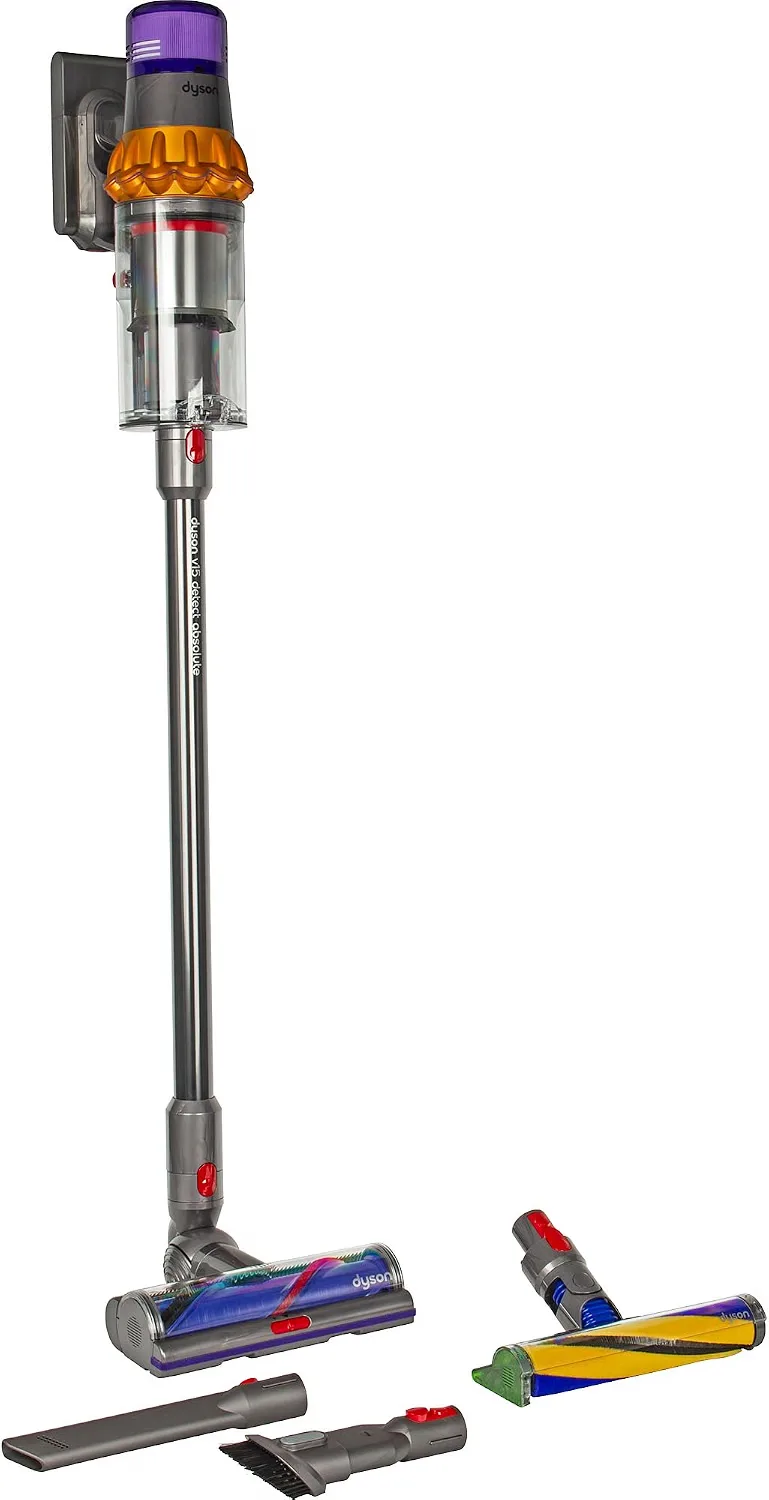
A laser to see fine dust, a sensor that counts particles, a head that untangles hair and up to 60 minutes in Eco mode: enough to replace your cylinder vacuum.
- Laser
- Up to 60 min
- 0.76 L bin
How the calculator chooses the machine
The rules are simple and public. They reflect the strengths and limitations of the machines described in our guides, with no opaque algorithm.
| Your situation | Recommended machine |
|---|---|
| 45 m² or less, mostly hard or mixed floors, no pets | A light stick vacuum |
| Cleaning time up to 70% of the claimed Eco runtime | A high-end stick vacuum |
| Cleaning time between 70% and 100% of the claimed Eco runtime | A high-end stick vacuum, if you manage the modes |
| Cleaning time beyond the claimed Eco runtime | A stick vacuum with a second battery, or a cylinder or robot alongside |
The 30% margin reflects a simple fact: the claimed runtime applies in Eco mode on hard floors. With the motorised head and Auto mode, the battery runs down faster. Aiming for a clean that fits within 70% of the maximum runtime leaves room for rugs and stubborn spots.
How cleaning time is estimated
The calculator multiplies your floor area by an average time per square metre, which depends on your floors:
- Mostly hard floors: about 15 seconds per m²;
- Mixed floors: about 19 seconds per m²;
- Mostly rugs and carpet: about 24 seconds per m², because you move more slowly and go over each area in both directions.
With a dog or cat, it adds 20%: hair needs extra passes, more frequent bin emptying and a pass over the sofa. These values are editorial estimates, not measurements. They are there to compare orders of magnitude.
The calculator then shows how many sessions one charge allows in Eco mode, the runtime in Boost mode and the time spent vacuuming over a year, based on the number of sessions per week you enter.
The runtimes used
| Figure | Value | Source |
|---|---|---|
| Maximum runtime | Up to 60 min in Eco mode, on hard floors | Dyson France specification sheet |
| Boost runtime | 5 min | Dyson France specification sheet |
| Charging time | 4.5 hours | Dyson France specification sheet |
No runtime is published for Auto mode, because it depends on the floor and the dust detected. The calculator does not make one up. To understand these differences, read our article battery and runtime.
What the calculator does not take into account
- How cluttered your home is: lots of furniture slows cleaning down.
- Battery ageing, which reduces runtime over the years.
- Rooms you do not vacuum every session.
- Time spent emptying the bin and changing tools.
To go further, read our guide how to choose a cordless vacuum cleaner and our comparison cordless, cylinder or robot.
Frequently asked questions
How long does it take to vacuum 100 m²?
By our estimates, about 25 minutes on hard floors, just over 30 minutes on mixed floors and 40 minutes on carpet, not counting corners.
Is one charge enough for a house?
For an average house in Eco or Auto mode, often yes. Beyond that, a second battery or cleaning in two sessions becomes useful.
Why does the calculator not give the runtime in Auto mode?
Because Dyson does not publish it: it varies with the floor and the dust detected. We prefer not to invent a figure.