Watts, airwatts, pascals and runtime: reading the figures of a stick vacuum
660 W, 240 AW, 25,000 Pa, 60 minutes: every product listing lines up impressive figures that do not measure the same thing. Here is what each unit really tells you, how to compare them and why real-world runtime is always shorter than the claimed figure.
Contents
How a vacuum picks up dirt
Strictly speaking, a vacuum does not “pull” dust. Its motor spins a fan that pushes air out of the machine. This creates, in the wand and the head, a pressure lower than that of the room. The surrounding air rushes in to fill the gap and carries dust, crumbs and hair with it. It then passes through a separation system (cyclones and filters) that holds back the debris, before leaving the machine.
Two quantities describe this process:
- low pressure, the pressure difference created, which determines how strongly air is drawn through a narrow opening;
- airflow, the volume of air that moves each second, which determines how much debris is carried along.
A good vacuum combines the two. Strong low pressure without airflow struggles to lift bulky debris; strong airflow without low pressure cannot loosen dust embedded in a rug. Every figure on a product listing tries to summarise one or the other, with varying degrees of honesty.
Watts: a consumption figure
The figure in watts (W) is the electrical power drawn by the motor. It tells you how much energy the machine takes from the battery, not what it does with it. Part of that energy is lost as heat, noise and friction in the airflow path and in the head.
The Dyson V15 Detect is quoted at 660 W. That figure explains why its battery runs down in 5 minutes in Boost mode: the motor is then running flat out. On its own, it does not tell you that it cleans better than a 450 W machine designed differently.
Remember: electrical watts are useful for estimating consumption and the load on the battery. They do not measure suction efficiency. Two machines with the same electrical power can clean very differently.
Pascals: a low-pressure figure
Many manufacturers, especially for entry-level and mid-range models, highlight a figure in pascals (Pa) or kilopascals (kPa): 18,000 Pa, 25,000 Pa, 30 kPa. This is the maximum low pressure the motor can create, usually measured at the motor inlet with the opening sealed.
This figure has two weaknesses. It ignores airflow: the machine can create strong low pressure on a blocked opening and move little air in real use. And it is rarely measured to a common protocol: you do not always know whether it refers to the motor alone or to the complete machine, with the wand and head that lose some of the low pressure.
A high figure in pascals is not a bad sign, but it cannot be compared with airwatts, nor with the pascals of another manufacturer who measures differently.
Airwatts: the most useful figure
The airwatt (AW) combines low pressure and airflow into a single value. It expresses the power actually transferred to the air moving through the machine. It is the indicator closest to what matters to you: the ability to carry dust away.
To give an idea of scale, entry-level stick vacuum makers rarely publish their airwatts, while makers of high-end models highlight them, with maximum values running into the hundreds of airwatts. Dyson claims 230 AW in Boost for the original V15 Detect and 240 AW for the recent version.
Even airwatts should be read with care. The published value refers to the maximum mode, used for a few minutes. In Auto or Eco mode, power is much lower. And everything depends on how the measurement was carried out.
Note also that suction and pick-up are not the same thing. A machine moves air; what ends up in the bin depends on how well the head loosens the dirt and keeps the airflow close to the floor. That is why the same airwatts can give different results from one design to another.
How the measurement changes the figure
The same machine can show very different figures depending on how it is measured:
- Empty or full bin: a full bin and a loaded filter slow the air down. Measuring with a full bin gives a lower but more realistic figure. Dyson states that it measures to the EN IEC 62885-4 standard, with a full bin.
- Motor alone or complete machine: the wand, bends and head create losses. A figure measured at the motor is always more flattering.
- Full or nearly flat battery: some batteries deliver less power as they run down. The best machines keep power constant until the end.
- Mode used: the maximum value corresponds to Boost. The everyday mode is more modest.
The European standards in the EN 60312 and EN IEC 62885 series define common protocols for measuring dust pick-up on different floors. Independent testing organisations, such as Que Choisir in France, measure the amount of dust actually picked up on carpet, on hard floors and in crevices. These results are more telling than any power figure.
The head matters as much as the motor
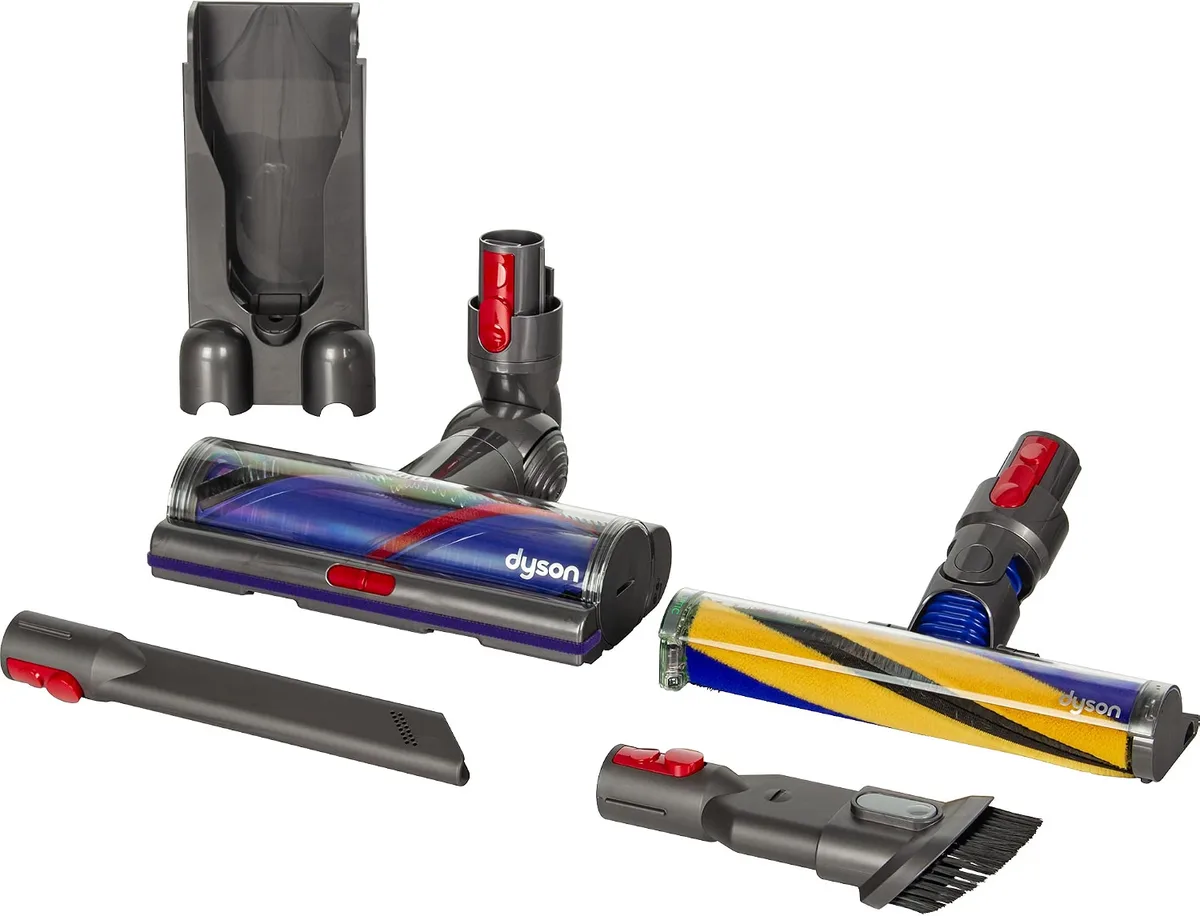
With equal power, two vacuums can achieve very different results because of their heads. On a rug, it is the motorised brush bar that loosens dust from the fibres with its stiff bristles; suction then simply carries it away. On a hard floor, a soft roller pressed close to the floor picks up both fine dust and bulky debris, where a stiff-bristled head flicks large pieces away.
How well the head seals against the floor also plays a part: a head that lets air in at the sides loses effectiveness. That is why independent tests sometimes favour a less powerful but better-designed machine.
Claimed runtime and real-world runtime
This is the main source of disappointment among buyers. The headline runtime almost always corresponds to the most economical configuration: lowest mode, non-motorised head or simple tool, hard floor, new battery at room temperature.
For the V15 Detect, Dyson claims up to 60 minutes in Eco mode on hard floors, and 5 minutes in Boost. These two values frame real use. In Auto mode with the Digital Motorbar, the duration depends on the home: on a clean wood floor, power stays low and runtime is longer; on carpet or with lots of dust, power rises and runtime gets shorter.
Several factors reduce runtime:
- the motorised head, whose own motor draws power on top of suction;
- rugs and carpets, which slow the brush bar and trigger the power increase;
- cold: a cold lithium-ion battery delivers less energy;
- ageing: after a few hundred cycles, capacity decreases;
- a clogged filter, which makes the motor work harder.
To find out whether the runtime is enough for you, estimate your cleaning time with our calculator, and read our article on the battery and its lifespan.
Which vacuum for your home?
Answer a few questions: we suggest the most suitable type of machine and estimate your cleaning time, compared with the runtime Dyson claims for the V15.
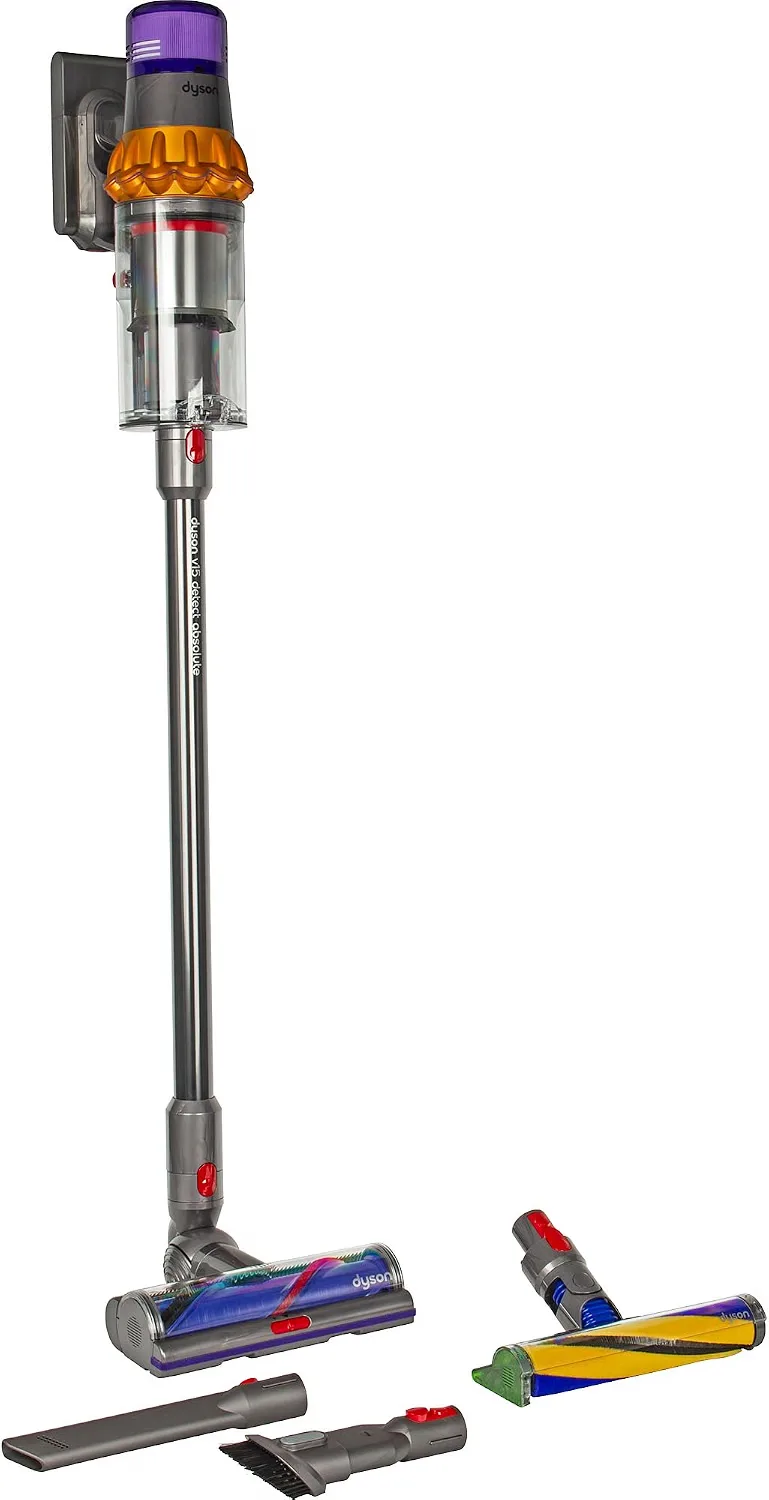
A laser to see fine dust, a sensor that counts particles, a head that untangles hair and up to 60 minutes in Eco mode: enough to replace your cylinder vacuum.
- Laser
- Up to 60 min
- 0.76 L bin
Modes and consumption
Most stick vacuums offer two to four modes. The principle is always the same: the more powerful the mode, the higher the consumption and the shorter the runtime, and far more than proportionally.
| Mode | Power | Runtime | Recommended use |
|---|---|---|---|
| Eco or low | Low | Maximum | Hard floors, routine cleaning, light dust |
| Auto or medium | Variable or intermediate | Intermediate | General use, mixed floors |
| Boost or maximum | Maximum | A few minutes | Very dirty areas, thick rugs, occasionally |
Automatic mode, where available, is the best compromise: the machine only uses power where it is needed. On the V15 Detect, it relies on a piezoelectric dust sensor and on the resistance of the Digital Motorbar brush bar, according to Dyson. Keep Boost for a few seconds on a specific spot: a patch of soil, a corner of a rug, a pet bed.
How to compare two machines
Faced with two product listings, work in this order:
- Look for an independent test that measures the dust picked up on your floors. It is the most reliable information.
- Compare airwatts if both manufacturers publish them, checking the measurement conditions.
- Ignore comparisons of pascals between different brands, for lack of a common protocol.
- Compare runtime in the intermediate mode with the motorised head, if it is published or measured by a test.
- Look at the heads supplied and how well they suit your floors.
- Consider weight and handling, which matter as much as power day to day.
Our guide how to choose a cordless vacuum cleaner covers every criterion, with a checklist to go through before you buy.
Misconceptions about power
- “More watts means more suction.” Watts measure consumption. A well-designed machine cleans better with fewer watts than a poorly designed one.
- “Maximum mode cleans better everywhere.” On a clean hard floor, Eco mode picks up dust just as well and saves the battery.
- “A powerful vacuum damages rugs.” It is the brush bar, not suction, that can damage a delicate rug. Choose the right head.
- “Power inevitably drops over time.” It drops mainly if the filter is not maintained. A well-maintained machine keeps most of its performance.
Keeping the power over time
Claimed power applies to a new, clean machine. To keep it, three habits are enough: empty the bin before it is full, wash the filter as often as the manual recommends, and remove hair wrapped around the brush bars. A partly blocked wand also causes suction to drop without you noticing. Our guide filter and brush bar maintenance explains the method.
The case of the Dyson V15 Detect
| Figure | Claimed value | What it means |
|---|---|---|
| Motor speed | 125,000 rpm | A compact motor capable of strong low pressure |
| Electrical power | 660 W | Consumption at full power |
| Suction | 230 AW (original version), 240 AW (recent version), in Boost, full bin | The power transferred to the air, measured demandingly |
| Runtime | Up to 60 min in Eco on hard floors, 5 min in Boost | The two extremes; real use lies in between |
| Charging | 4.5 hours | A full recharge overnight or between widely spaced sessions |
These values place the V15 Detect among the most powerful stick vacuums on the market. They do not prevent a real-world runtime much shorter than 60 minutes in mixed use with the motorised head. That is the trade-off of any powerful stick vacuum. The details are in our specifications explained and our full review.
Frequently asked questions
What is the difference between watts and airwatts?
Watts measure the electricity used by the motor; airwatts, the power transferred to the air drawn in. The second is far more meaningful for efficiency.
Is 25,000 Pa a lot?
It is high low pressure, but it says nothing about airflow and is not measured consistently from one brand to another. Do not compare pascals between manufacturers.
Why does my vacuum last less time than claimed?
The claimed runtime applies in Eco mode on hard floors. With the motorised head, on carpet or in a more powerful mode, it falls sharply.
Does Boost mode damage the battery?
Occasional use is planned for by the manufacturer. Constant use puts more strain on the battery and drains it very quickly: keep it for stubborn areas.
Are more airwatts always better?
Under equal measurement conditions, more airwatts means more suction power. The final result also depends on the head and how well the machine is sealed.
Why do not all manufacturers publish airwatts?
Nothing obliges them to, and a figure in pascals often looks more impressive. The absence of airwatts is not necessarily a bad sign, but it makes comparison harder.
Can a stick vacuum be as powerful as a cylinder?
High-end models get close in maximum mode. The cylinder keeps the advantage of being able to sustain its power with no time limit.
Does the size of the bin affect suction?
Not directly, but a bin that is too full reduces airflow and therefore suction. Empty it before the max line to keep full power.
Is a heavier stick vacuum more powerful?
Not necessarily. Weight depends on the battery, the materials and where the motor sits. Compare suction figures and independent tests, not weight.
Is suction the same at the start and end of a charge?
On good machines, power stays steady until the battery is nearly flat. On some models, it drops towards the end of the charge.
Cleaning you can finally see.
Laser · piezo sensor · up to 60 min in Eco · 0.76 L bin · 2-year guarantee. The price changes often on Amazon: check it, along with the seller, the exact version and the tools included, before you order.
Check the price on AmazonAffiliate link · new tab